2021 FDA Science Forum
Core Genome MLST for Source Attribution of Campylobacter Coli
- Authors:
- Center:
-
Contributing OfficeCenter for Veterinary Medicine
Abstract
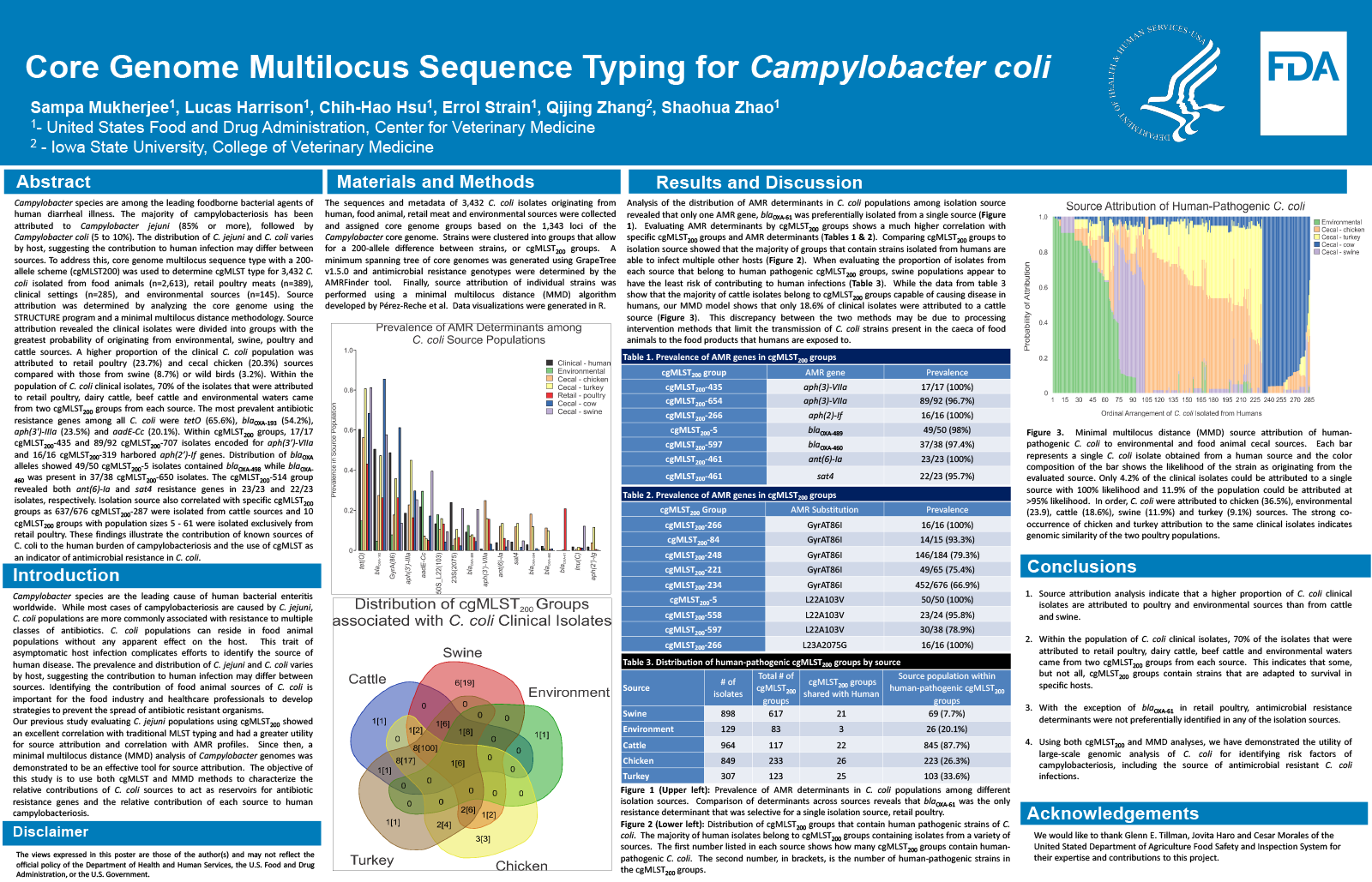
Campylobacter species are among the leading foodborne bacterial agents of human diarrheal illness. The majority of campylobacteriosis has been attributed to Campylobacter jejuni (85% or more), followed by Campylobacter coli (5 to 10%). The distribution of C. jejuni and C. coli varies by host, suggesting the contribution to human infection may differ between sources. To address this, core genome multilocus sequence type with a 200-allele scheme (cgMLST200) was used to determine cgMLST type for 3,432 C. coli isolated from food animals (n=2,613), retail poultry meats (n=389), clinical settings (n=285), and environmental sources (n=145). Source attribution was determined by analyzing the core genome using the STRUCTURE program and a minimal multilocus distance methodology. Source attribution revealed the clinical isolates were divided into groups with the greatest probability of originating from environmental, swine, poultry and cattle sources. A higher proportion of the clinical C. coli population was attributed to retail poultry (23.7%) and cecal chicken (20.3%) sources compared with those from swine (8.7%) or wild birds (3.2%). Within the population of C. coli clinical isolates, 70% of the isolates that were attributed to retail poultry, dairy cattle, beef cattle and environmental waters came from two cgMLST200 groups from each source. The most prevalent antibiotic resistance genes among all C. coli were tetO (65.6%), blaOXA-193 (54.2%), aph(3')-IIIa (23.5%) and aadE-Cc (20.1%). Within cgMLST200 groups, 17/17 cgMLST200-435 and 89/92 cgMLST200-707 isolates encoded for aph(3’)-VIIa and 16/16 cgMLST200-319 harbored aph(2’)-If genes. Distribution of blaOXA alleles showed 49/50 cgMLST200-5 isolates contained blaOXA-498 while blaOXA-460 was present in 37/38 cgMLST200-650 isolates. The cgMLST200-514 group revealed both ant(6)-Ia and sat4 resistance genes in 23/23 and 22/23 isolates, respectively. Isolation source also correlated with specific cgMLST200 groups as 637/676 cgMLST200-287 were isolated from cattle sources and 10 cgMLST200 groups with population sizes 5 - 61 were isolated exclusively from retail poultry. These findings illustrate the contribution of known sources of C. coli to the human burden of campylobacteriosis and the use of cgMLST as an indicator of antimicrobial resistance in C. coli.