2021 FDA Science Forum
Contributions of Mitochondrial Damage and Hepatocyte Toxicity to Pexidartinib-Induced Hepatotoxicity
- Authors:
- Center:
-
Contributing OfficeNational Center for Toxicological Research
Abstract
Background
Pexidartinib is a recently approved small molecule kinase inhibitor (KI) to treat adults with tenosynovial giant cell tumor. Pexidartinib has a boxed warning for hepatotoxicity and thus, is available only through the FDA Risk Evaluation and Mitigation Strategy (REMS) program.
Purpose
Since mitochondrial liability and direct hepatocyte cytotoxicity have been associated with KI-induced hepatotoxicity, the effects of pexidartinib on mitochondrial functions and hepatocyte viability were examined. Methodology: Freshly isolated rat liver mitochondria, submitochondrial fractions, and cryopreserved primary human hepatocytes (PHHs) were treated with pexidartinib at clinically-relevant concentrations, and mitochondrial function and cytotoxicity were assessed.
Results
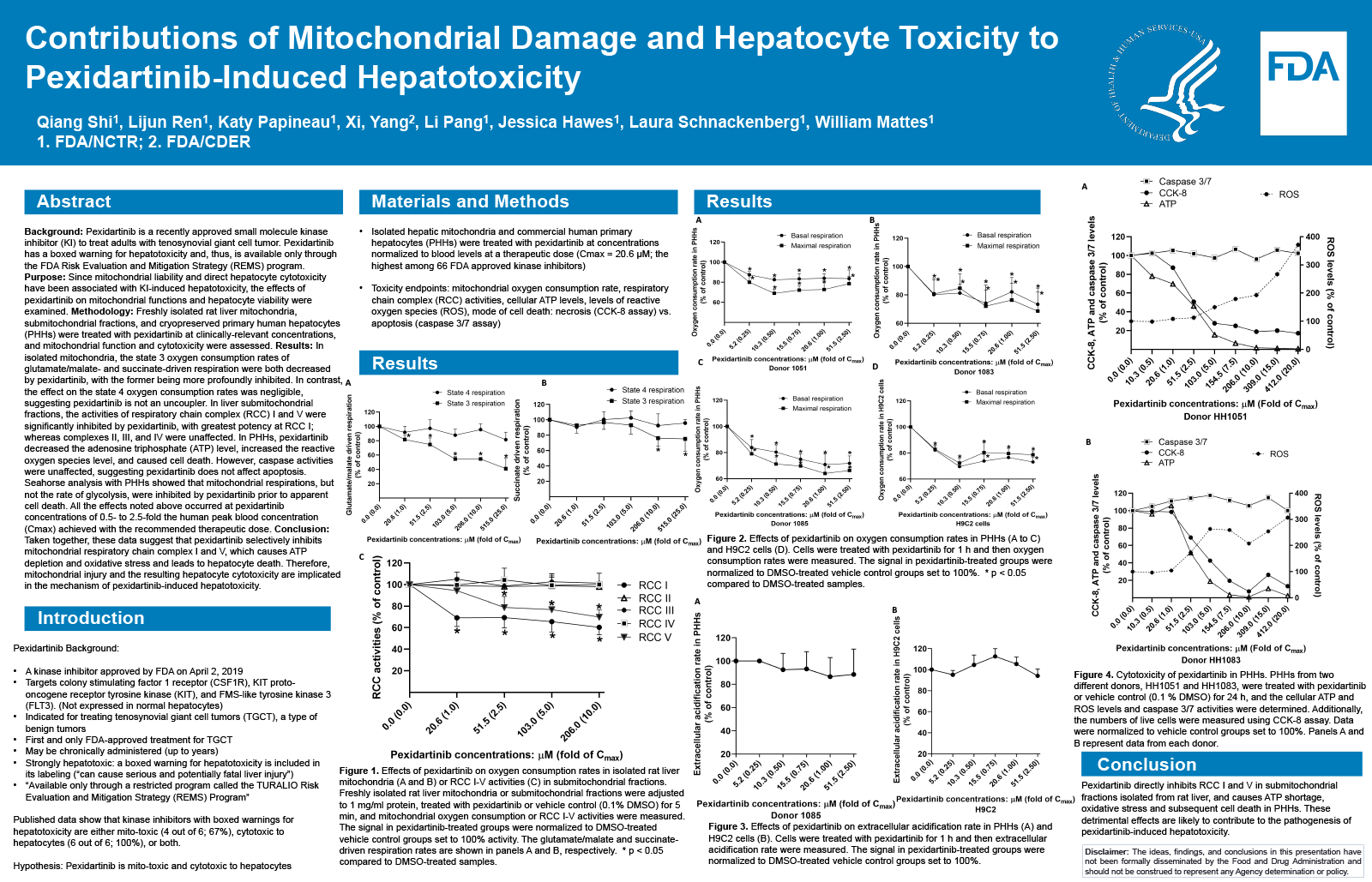
In isolated mitochondria, the state 3 oxygen consumption rates of glutamate/malate- and succinate-driven respiration were both decreased by pexidartinib, with the former being more profoundly inhibited. In contrast, the effect on the state 4 oxygen consumption rates was negligible, suggesting pexidartinib is not an uncoupler. In liver submitochondrial fractions, the activities of respiratory chain complex (RCC) I and V were significantly inhibited by pexidartinib, with greatest potency at RCC I; complexes II, III, and IV were unaffected. In PHHs, pexidartinib decreased the adenosine triphosphate (ATP) level, increased the reactive oxygen species level, and caused cell death. However, caspase activities were unaffected, suggesting pexidartinib does not affect apoptosis. Seahorse analysis with PHHs showed that mitochondrial respirations, but not the rate of glycolysis, were inhibited by pexidartinib prior to apparent cell death. All the effects noted above occurred at pexidartinib concentrations of 0.5- to 2.5-fold the human peak blood concentration (Cmax) achieved with the recommended therapeutic dose.
Conclusion
Taken together, these data suggest that pexidartinib selectively inhibits mitochondrial respiratory chain complex I and V which causes ATP depletion and oxidative stress and leads to hepatocyte death. Therefore, mitochondrial injury and the resulting hepatocyte cytotoxicity are implicated in the mechanism of pexidartinib-induced hepatotoxicity.