2021 FDA Science Forum
Considerations for Uncertainty Factor Determination in Medical Device Extractables Analysis
- Authors:
- Center:
-
Contributing OfficeCenter for Devices and Radiological Health
Abstract
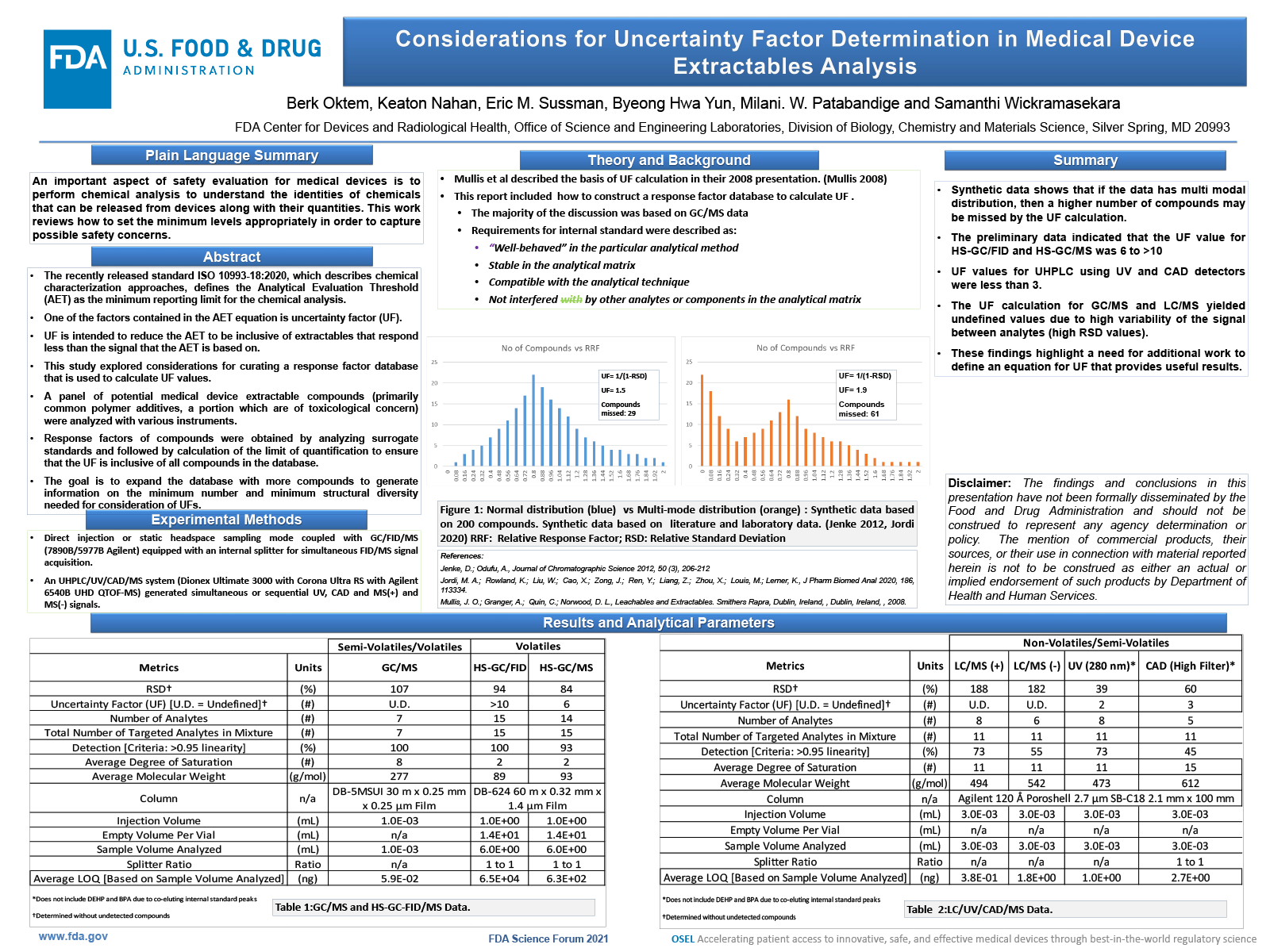
Extraction of medical device materials leads to the release of extractables, which can include impurities, processing additives, and material breakdown products. These extractables have potential consequence on the biological response to the device during its use. Chemical characterization studies are followed up with toxicological risk assessments, which evaluate potential harm from exposure to the extractables. The recently released standard ISO 10993-18:2020, which describes chemical characterization approaches, defines Analytical Evaluation Threshold (AET) and recommends its use in device extractables analysis. One of the factors contained in the AET equation is uncertainty factor (UF), which is intended to reduce the reporting limit to be inclusive of extractables that are lower-responding than the level of signal that the AET is based on. This study explored considerations for curating a response factor database that is used to calculate UF values. A panel of potential medical device extractable compounds (primarily common polymer additives, a portion which are of toxicological concern) were analyzed with various instruments. Using either direct injection or headspace sampling mode, a GC/FID/MS (7890B/5977B Agilent) equipped with an internal splitter enabled simultaneous FID and MS signal acquisition. Also, an UHPLC/UV/CAD/ MS system (Dionex Ultimate 3000, Dionex Corona Ultra RS, Agilent 6540B UHD QTOF-MS) generated both UV, CAD and MS signals. Response factors of compounds were obtained by analyzing known amounts. UFs necessary to be inclusive of all compounds and limits of quantification (LOQ) were calculated. The initial data indicated the UF of HS-GC/FID and HS-GC/MS is 6 to 10. Similarly, UF for UHPLC detection using UV and CAD detectors were less than 3. The UF for MS yielded undefined values due to high variability of the signal between analytes. These findings, with additional work, underscores that alternative approaches for defining the UF should be considered. This ongoing work continues to expand with more compounds to generate information on the minimum number and minimum structural diversity needed for justification of UFs.