2023 FDA Science Forum
Comparative assessment of the binding and neutralization activity of bispecific antibodies against SARS-CoV-2 variants
- Authors:
- Center:
-
Contributing OfficeCenter for Drug Evaluation and Research
Abstract
Background
Bispecific antibodies (BsAbs) against SARS-CoV-2 represent a promising class of therapeutics in the fight against COVID-19 due to their ability to target two non-overlapping epitopes on the spike protein. By doing so, they can effectively block ACE2-spike protein interaction, thereby possibly reducing infectivity and severity of disease. The complexity associated with this class of antibodies requires adequate bioassays to ensure product quality and manufacture consistency.
Purpose
While most developmental antibodies are characterized by their binding affinity and neutralization activity using techniques such as surface plasmon resonance (SPR) and cell-based assays such as reporter assays or plaque reduction neutralization tests (PRNT), these methods are technically demanding, low throughput and time-consuming, thus limiting their applications for lot release testing in quality control (QC) laboratories. Thus, we aimed to develop alternative techniques that can provide a comparative assessment of the binding and neutralization of bispecific antibodies against SARS-CoV-2.
Methodology
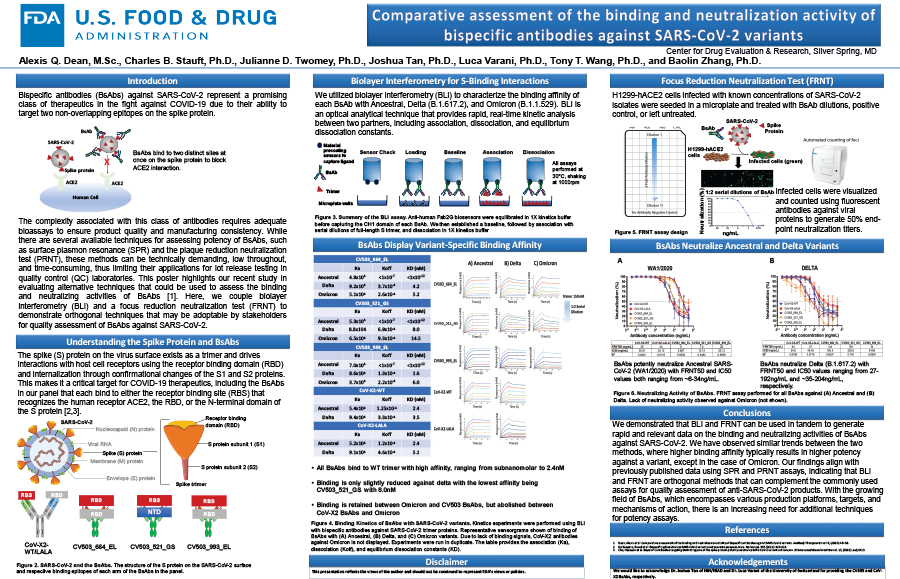
We acquired and tested a panel of five experimental BsAbs against SARS-CoV-2 to evaluate biolayer interferometry (BLI) and a focus reduction neutralization tests (FRNT) protocol for binding and neutralization activity. Using BLI, we conducted parallel analysis of the binding kinetics between antibody samples and spike proteins of SARS-CoV-2 variants of concern (e.g, Ancestral, Delta, Omicron). We also developed procedures for FRNT utilizing an engineered cell line expressing human ACE2 and treated with live virus isolates of the same variants to generate IC50 and FRNT50 values for each sample.
Results
We demonstrated comparable trends between BLI-derived binding affinity and FRNT-based virus neutralization activity for a wide range of SARS-CoV-2 variants. Higher apparent binding affinity captured by BLI was complemented by increased anti-viral potency in the FRNT assays. The data collected was also in line previously published results using SPR and PRNT.
Conclusion
The continuous circulation of SARS-CoV-2 variants heightens the need for technologies that can rapidly assess the potency of antibody therapeutics against SARS-CoV-2. Our data support the applications of BLI coupled with the FRNT assays to assess the binding and virus neutralization activity of anti-SARS-CoV-2 antibodies.