2023 FDA Science Forum
C. elegans adult activity assay: Model for comparative toxicology
- Authors:
- Center:
-
Contributing OfficeCenter for Food Safety and Applied Nutrition
Abstract
Introduction:
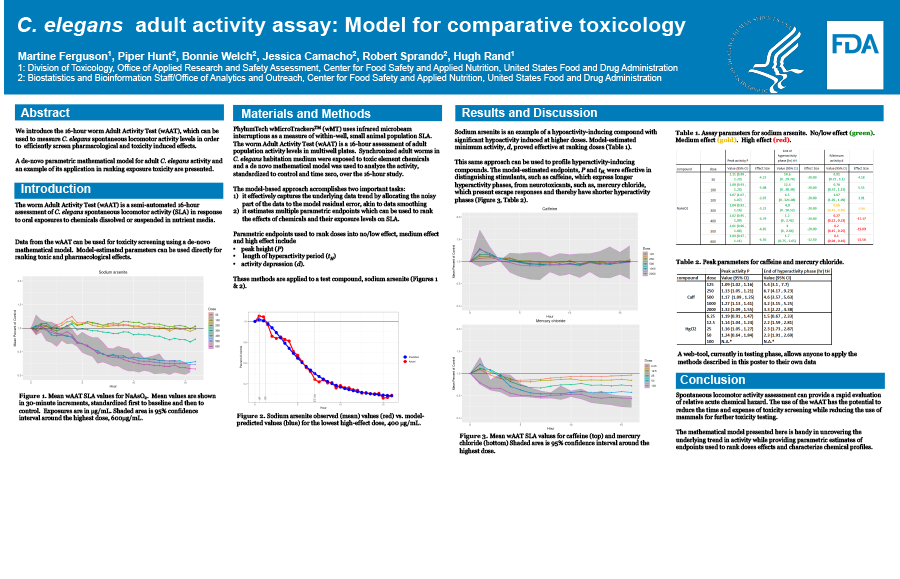
Novel methods were developed to analyze data obtained from a semi-automated method for tracking adult C. elegans spontaneous locomotor activity. Data from the 16-hour worm Adult Activity Test (wAAT) can be used for toxicity screening using a de-novo mathematical model. Model-estimated parameters can be used directly for ranking toxic and pharmacological effects.
Purpose:
Evaluate longitudinal locomotor activity changes after exposure of adult C. elegans to heavy metals. Develop a mathematical model which 1) smooths the data and 2) whose parameters are used directly for estimating effects on activity.
Methods:
The wMicroTracker (wMT) uses infrared microbeam interruptions as a measure of within-well, small animal population spontaneous locomotor activity. The worm Adult Activity Test (wAAT) is a 16-hour assessment of adult population activity levels in multiwell plates. Synchronized adult worms in C. elegans habitation medium were exposed to toxic element chemicals methylmercury chloride and sodium arsenite, as well as dimethylarsinic acid. A mathematical model was used to analyze the activity, standardized to control and time zero, over the 16-hour study. This model achieves two purposes: 1) the data is smoothed by uncovering the underlying trend and filtering out the noisiness (model residual error) while 2) the model-estimated parameters are used to directly calculate dose-effect endpoints such as minimum activity and the duration of any hyperactivity phase.
Results:
Model-estimated minimum activity proved effective at ranking doses within compound with high doses expressing acute activity depression over time and low doses expressing no or slight activity depression. The model-estimated length of the hyperactivity phase proved important in distinguishing types of compounds, with non-toxic irritants or stimulants expressing short hyperactivity followed by recovery to approximate control levels, hypoactivity-inducing toxicants or paralytics which induce immediate and acute activity depression, or neurotoxicants which may express prolonged periods of hyperactivity.
Significance:
The model-based approach accomplishes two important tasks: 1) smooths the data and 2) estimates parametric endpoints which appropriately capture the dose and compound effects on activity. The use of the wAAT has the potential to reduce the time and expense of toxicity screening while expediting toxicant identification and facilitating more efficient and sparing use of mammals for further toxicity testing.