2021 FDA Science Forum
Build Parameter Influence on Strut Thickness and Subsequent Mechanical Integrity in 3D Printed Titanium Lattice Structures
- Authors:
- Center:
-
Contributing OfficeCenter for Devices and Radiological Health
Abstract
Background
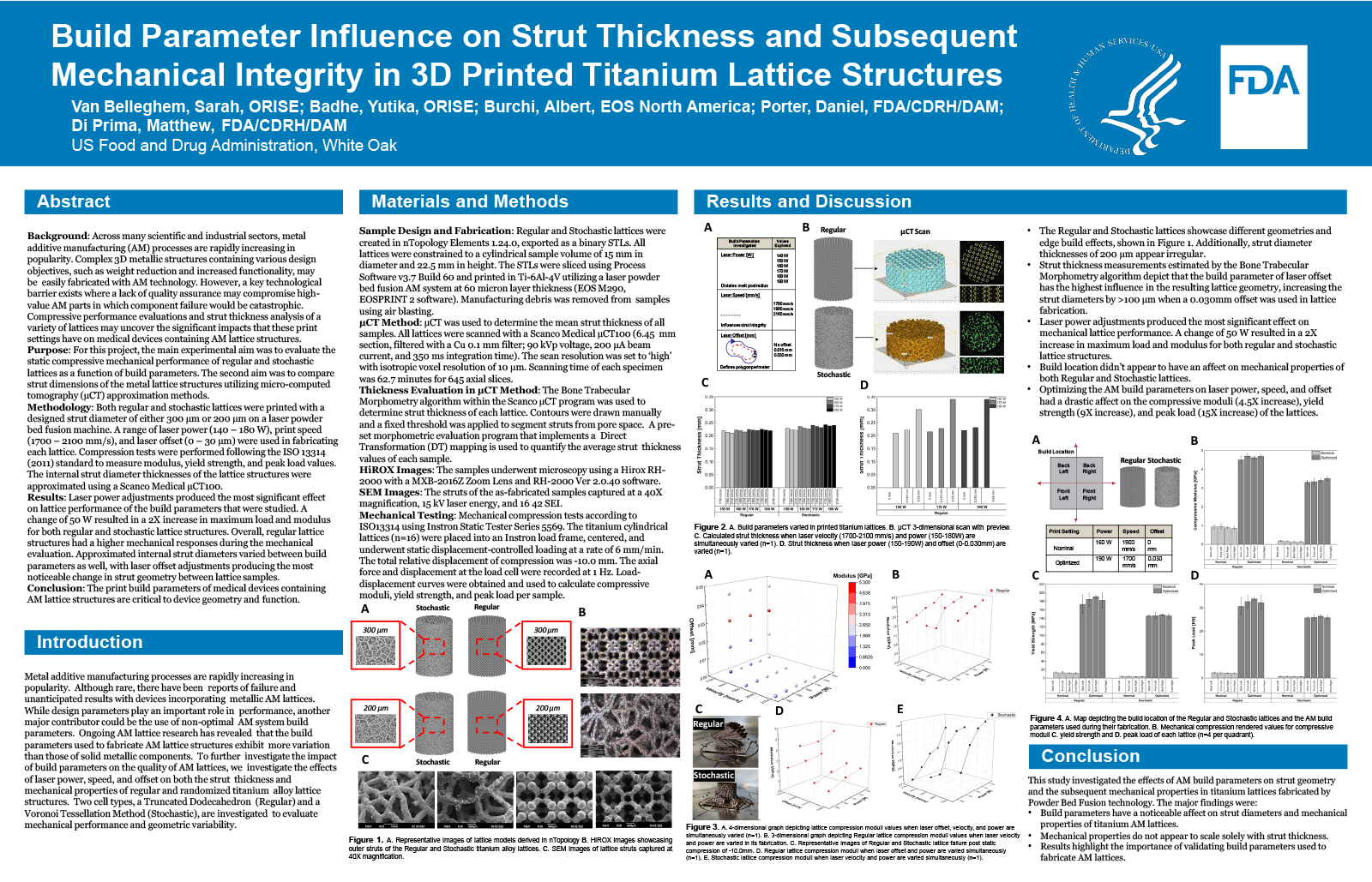
Across many sectors such as aerospace and medical sectors, metal additive manufacturing (AM) processes are rapidly increasing in popularity. Complex 3D metallic structures containing various design objectives, such as light-weighting and increased functionality, may be easily fabricated with AM technology. However, a key technological barrier exists where a lack of quality assurance may compromise high-value AM parts in which component failure would be catastrophic. Compressive performance evaluations and strut thickness analysis of a variety of lattices may uncover the significant impacts that these print settings have on medical devices containing AM lattice structures.
Purpose
There are two specific main experimental aims for this project: 1. To evaluate the static compressive mechanical performance of regular and stochastic lattices as a function of build parameters 2. To compare the strut dimensions of the metal lattice structures via µCT and optical methods (ASTM F1854)
Methodology
Both regular and stochastic lattices were printed with a designed strut diameter of 300µm on a laser powder bed fusion machine. A range of laser power (140 – 180 W,) and print speed (1700 - 2100 mm/s) were used in fabricating each lattice samples. Compression tests were performed following the ISO 13314(2011) standard to measure modulus, yield strength, and max stress values. The internal strut diameter thicknesses of the lattice structures were approximated using a ScanCo Medical µCT100 and ASTM F1854. The effect of laser offset (0, 15 µm, 30 µm, 45 µm) on lattice strut thickness was also investigated.
Results
Laser power adjustments produced the most significant effect on lattice performance of the build parameters that were studied. A change of 40W resulted in a 2x increase in maximum load and modulus for both regular and stochastic lattice structures. Overall, regular lattice structures had higher mechanical responses during the mechanical evaluation. Discrepancies in estimated strut geometry exist between ScanCo Medical µCT100 and ASTM F1854 methods when calculating strut diameter values.
Conclusion
The print build parameters of medical devices containing AM lattice structures are critical to device geometry and function. Since µCT and ASTM F1854 evaluations rendered significant differences in strut thickness, additional testing is needed to establish a method by which to accurately quantify strut geometry metrics.