2021 FDA Science Forum
Benzo[a]pyrene in the Mainstream Smoke of Little Cigars
- Authors:
- Center:
-
Contributing OfficeCenter for Tobacco Products
Abstract
Background:
Little cigars (LCs), which are similar to cigarettes in dimensions, filters, and appearance, appeal to consumers, including youth, due to characterizing flavors, lower costs, and the perception of reduced risk. LCs contain similar mainstream smoke (MSS) constituents as cigarettes, but have different yields, which may result in different exposure to toxicants. Physical properties, tobacco blend additives and smoking behaviors also impact consumer exposure to the level of harmful chemicals in LC MSS versus cigarettes. For example, flavor appeal may result in different behaviors between LC smokers and cigarette smokers.
Purpose:
To investigate the relative toxicities and MSS yields of LCs and cigarettes in terms of benzo[a]pyrene (B[a]P), a human carcinogen, together with product physical properties that may impact MSS yields.
Methodology:
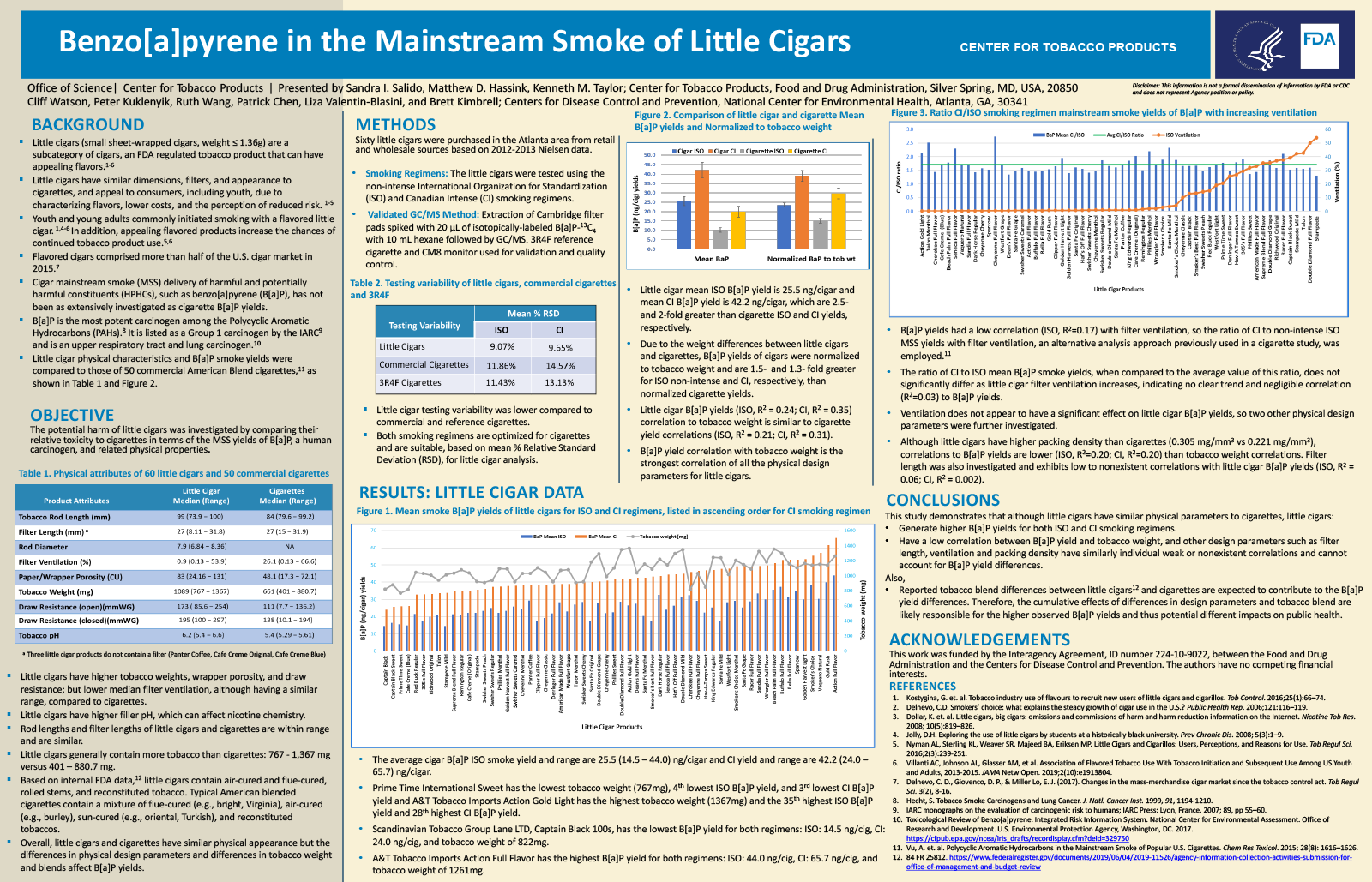
LCs were smoked using the International Organization of Standardization (ISO) non-intense and Canadian Intense (CI) smoking regimens followed by a GC/MS method.
Results:
The analytical variability of B[a]P in LCs (%RSD 9.6) and previously tested cigarettes (%RSD 14.5) was similar. Mean ISO yield (range) is 25.5 ng/cigar (14.5–44.0 ng/cigar) and CI yield is 42.2 ng/cigar (24.0–65.7 ng/cigar), which are 2.5 and 2 times greater, respectively, than cigarette yields. Because LCs generally contain more tobacco than cigarettes (767–1,367 mg versus 401–880 mg), normalized MSS yields were compared. After normalization, LC B[a]P yields are 1.5 (ISO) and 1.3 (CI) times greater than cigarette yields. B[a]P smoke yields are known to correlate with tobacco weight and LCs (CI, R2=0.35) and cigarettes (CI, R2=0.31) have similar correlations.
Conclusion:
LCs may be more appealing than cigarettes due to the variety of flavors. Smoking a more appealing combusted tobacco product can result in greater exposure to smoke toxicants. LCs generate higher B[a]P smoke yields than cigarettes. Reported design parameter and tobacco blend differences between LCs and cigarettes likely contribute to B[a]P smoke yield differences. In addition, the appeal of LCs compared to cigarettes may also lead to different consumer exposures.