2021 FDA Science Forum
A Bayesian Approach to Detection of Treatment-Related Effects in Toxicology Studies by Borrowing Information from Historical Control Animals
- Authors:
- Center:
-
Contributing OfficeCenter for Drug Evaluation and Research
Abstract
Background
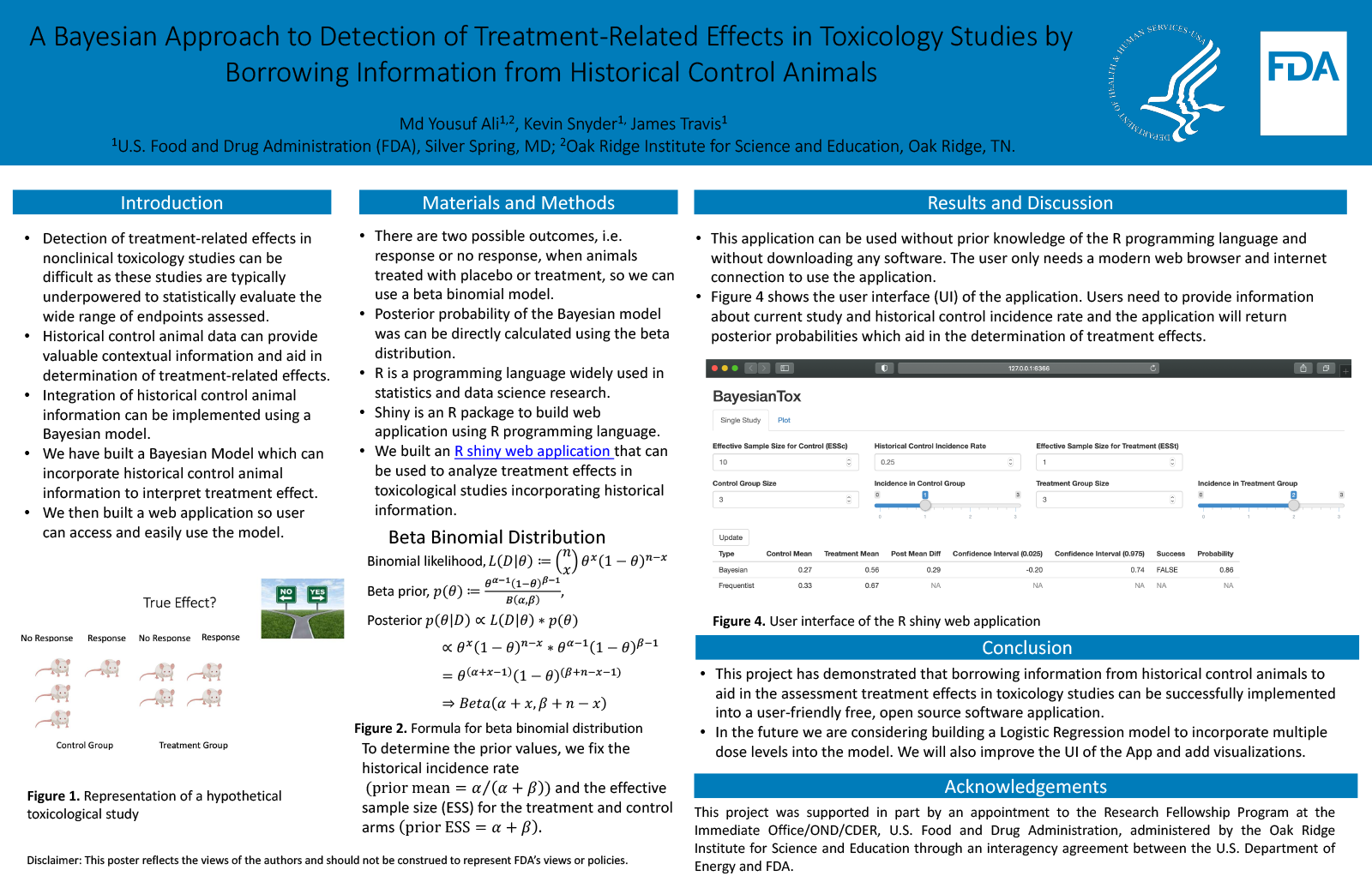
Detection of treatment-related effects in nonclinical toxicology studies can be difficult as these studies are typically underpowered to statistically evaluate the wide range of endpoints assessed. Subjective heuristic approaches are commonly employed to adjudicate whether or not a true treatment-related effect was observed by comparing the magnitude of a potential treatment effect against the variability historically observed among control animals; however, relevant historical control data are often not readily available and when available, it is not always clear how to best utilize this information. Fortunately, FDA/CDER routinely receives electronic standardized CDISC-SEND-formatted datasets along with toxicology study reports, which can function as a repository of historical control data, and Bayesian inference can be used to formally incorporate prior, i.e. historical, information into the interpretation of new study data.
Purpose
A Bayesian method was developed to integrate historical control data into the detection of treatment-related effects in toxicology studies.
Methodology
R scripts were written to extract relevant historical control data from a repository of SEND datasets and apply Bayesian inference to calculate the posterior probability of a treatment effect, given the data observed in the study of interest and the prior, i.e. historical, distribution of the study endpoint. These scripts were developed into an R Shiny web application that allows users to easily incorporate historical control data into their assessment of toxicology study results.
Results
The application can be used without prior knowledge of the R programming language and without downloading any software. The posterior probabilities reported by the software provide users with a useful estimation as to the likelihood that an observed potential treatment effect is real by formally accounting for the background distribution of the study endpoint in similar studies that were previously submitted, according to the criteria set by the user, e.g. animal species, animal age, route of administration, etc.
Conclusion
This project has demonstrated that borrowing information from historical control animals to aid in the assessment treatment effects in toxicology studies can be successfully implemented into a user-friendly free, open source software application.