2023 FDA Science Forum
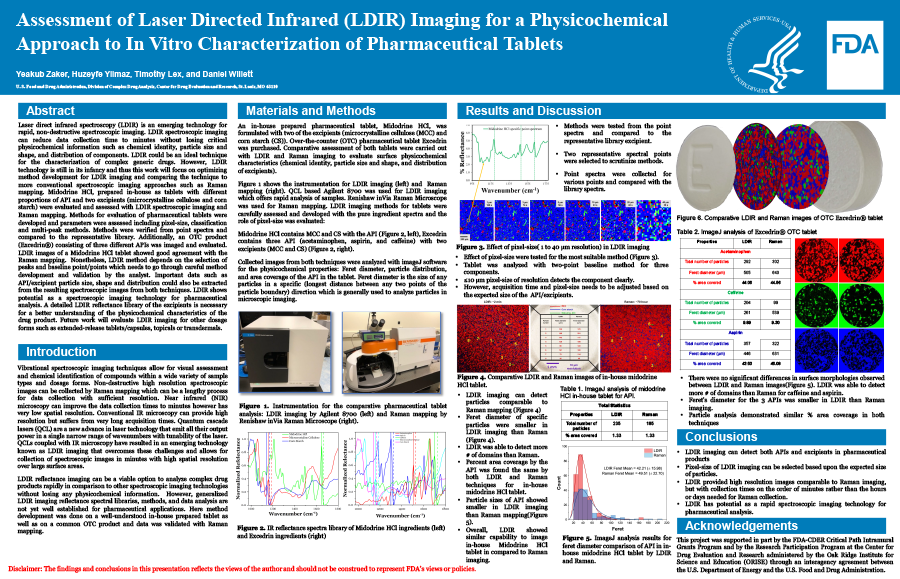
Assessment of Laser Directed Infrared (LDIR) Imaging for a Physicochemical Approach to In Vitro Characterization of Pharmaceutical Tablets
- Authors:
- Center:
-
Contributing OfficeCenter for Drug Evaluation and Research
Abstract
Laser direct infrared spectroscopy (LDIR) is an emerging technology for rapid, non-destructive spectroscopic imaging. LDIR spectroscopic imaging can reduce data collection time to minutes without losing critical physicochemical information such as chemical identity, particle size and shape, and distribution of components. LDIR could be an ideal technique for the characterization of complex generic drugs. However, LDIR technology is still in its infancy and thus this work will focus on optimizing method development for LDIR imaging and comparing the technique to more conventional spectroscopic imaging approaches such as Raman mapping. Midodrine HCl, prepared in-house as tablets with different proportions of API and two excipients (microcrystalline cellulose and corn starch) were evaluated and assessed with LDIR spectroscopic imaging and Raman mapping. Methods for evaluation of pharmaceutical tablets were developed and parameters were assessed including step-size, classification and multi-peak methods. Methods were verified from point spectra and compared to the representative library. Additionally, an OTC product (Excedrin®) consisting of three different APIs was imaged and evaluated. Classification method without normalizing showed better representation and had good agreement with the data collected from Raman mapping. Multi-peak method with two-points baseline provided better representation than other multi-peak and classification methods. LDIR images of a Midodrine HCl tablet is shown good agreement with the Raman mapping. Nonetheless, multi-peak methods depend on the selection of peaks and baseline point/points which needs to go through careful method development and validation by the analyst. Important data such as API/excipient particle size, shape and distribution could also be extracted from the resulting spectroscopic images from both techniques. LDIR shows potential as a spectroscopic imaging technology for pharmaceutical analysis. Multi-peak method with two-point baseline can provide a starting point for method development. A detailed LDIR reflectance library of the excipients is necessary to build up for further understanding the physicochemical characteristics of the drug product. Future work will evaluate LDIR imaging for other complex dosage forms such as extended-release tablets/capsules, topicals or transdermals.