2021 FDA Science Forum
Assessment of the Effects of Organic vs. Inorganic Arsenic and Mercury in Caenorhabditis Elegans
- Authors:
- Center:
-
Contributing OfficeCenter for Food Safety and Applied Nutrition
Abstract
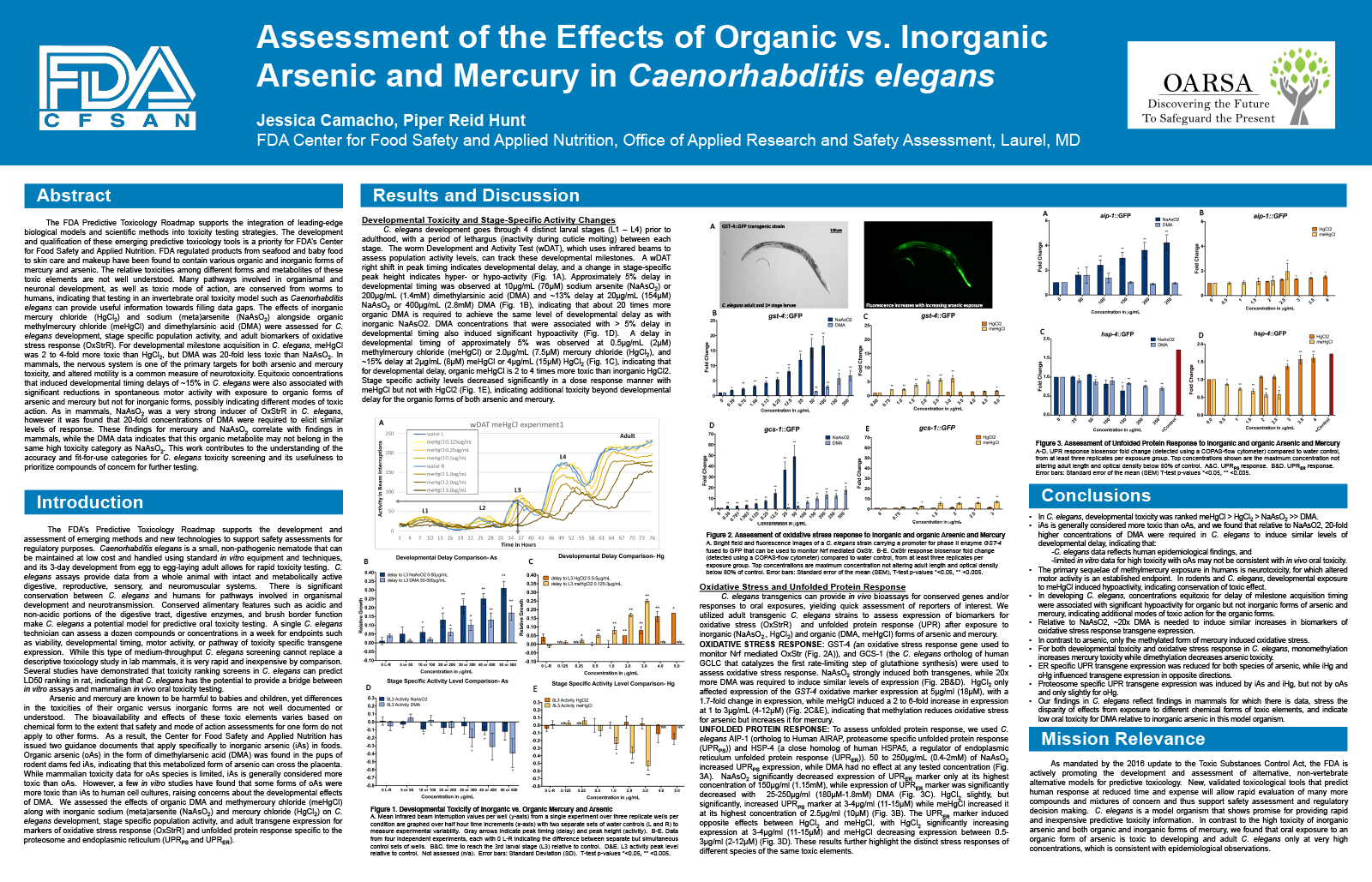
The FDA Predictive Toxicology Roadmap supports the integration of leading-edge biological models and scientific methods into toxicity testing strategies. The development and qualification of these emerging predictive toxicology tools is a priority for FDA’s Center for Food Safety and Applied Nutrition. FDA regulated products from seafood and baby food to skin care and makeup have been found to contain various organic and inorganic forms of mercury and arsenic. The relative toxicities among different forms and metabolites of these toxic elements are not well understood. Many pathways involved in organismal and neuronal development, as well toxic mode of action, are conserved from worms to humans, indicating that testing in an invertebrate oral toxicity model such as Caenorhabditis elegans can provide useful information towards filling data gaps. The effects of inorganic mercury chloride (HgCl2) and sodium (meta)arsenite (NaAsO2) alongside organic methylmercury chloride (meHgCl) and dimethylarsinic acid (DMA) were assessed for C. elegans development, stage specific population activity, and adult biomarkers of oxidative stress response (OxStrR).
For developmental milestone acquisition in C. elegans, meHgCl was 2 to 4-fold more toxic than HgCl2, but DMA was 20-fold less toxic than NaAsO2. In mammals, the nervous system is one of the primary targets for both arsenic and mercury toxicity, and altered motility is a common measure of neurotoxicity. Equitoxic concentrations that induced developmental timing delays of ~15% in C. elegans were also associated with significant reductions in spontaneous motor activity with exposure to organic forms of arsenic and mercury but not for inorganic forms, possibly indicating different modes of toxic action. As in mammals, NaAsO2 was a very strong inducer of OxStrR in C. elegans, however it was found that 20-fold concentrations of DMA were required to elicit similar levels of response. These findings for mercury and NaAsO2 correlate with findings in mammals, while the DMA data indicates that this organic metabolite may not belong in the same high toxicity category as NaAsO2. This work contributes to the understanding of the accuracy and fit-for-use categories for C. elegans toxicity screening and its usefulness to prioritize compounds of concern for further testing.