2021 FDA Science Forum
Assessing the Adhesion and Cytopathic Effects of Bordetella Pertussis in an In Vitro Human Airway Epithelial Tissue Model
- Authors:
- Center:
-
Contributing OfficeOffice of the Commissioner
Abstract
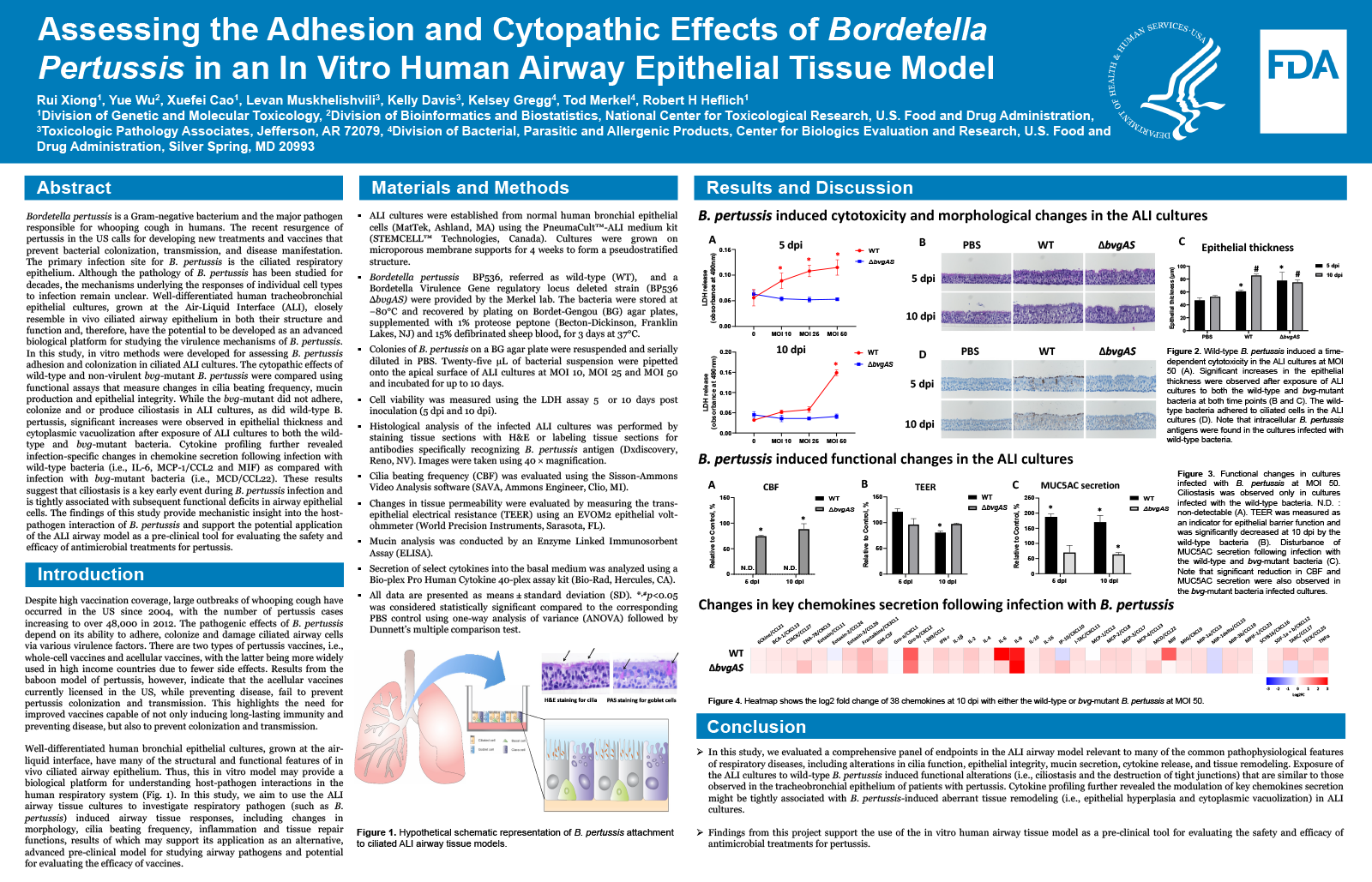
Bordetella pertussis is a Gram-negative bacterium and the major pathogen responsible for whooping cough in humans. The recent resurgence of pertussis in the US calls for developing new treatments and vaccines that prevent bacterial colonization, transmission, and disease manifestation. The primary infection site for B. pertussis is the ciliated respiratory epithelium. Although the pathology of B. pertussis has been studied for decades, the mechanisms underlying the responses of individual cell types to infection remain unclear. Well-differentiated human tracheobronchial epithelial cultures, grown at the Air-Liquid Interface (ALI), closely resemble in vivo ciliated airway epithelium in both their structure and function and, therefore, have the potential to be developed as an advanced biological platform for studying the virulence mechanisms of B. pertussis. In this study, in vitro methods were developed for assessing B. pertussis adhesion and colonization in ciliated ALI cultures. The cytopathic effects of wild-type and non-virulent bvg-mutant B. pertussis were compared using functional assays that measure changes in cilia beating frequency, mucin production and epithelial integrity. While the bvg-mutant did not adhere, colonize and or produce ciliostasis in ALI cultures, as did wild-type B. pertussis, significant increases were observed in epithelial thickness and cytoplasmic vacuolization after exposure of ALI cultures to both the wild-type and bvg-mutant bacteria. Cytokine profiling further revealed infection-specific changes in chemokine secretion following infection with wild-type bacteria (i.e. IL-6, MCP-1/CCL2 and MIF) as compared with infection with bvg-mutant bacteria (i.e. MCD/CCL22). These results suggest that ciliostasis is a key early event during B. pertussis infection and is tightly associated with subsequent functional deficits in airway epithelial cells. The findings of this study provide mechanistic insight into the host-pathogen interaction of B. pertussis and support the potential application of the ALI airway model as a pre-clinical tool for evaluating the safety and efficacy of antimicrobial treatments for pertussis.