2023 FDA Science Forum
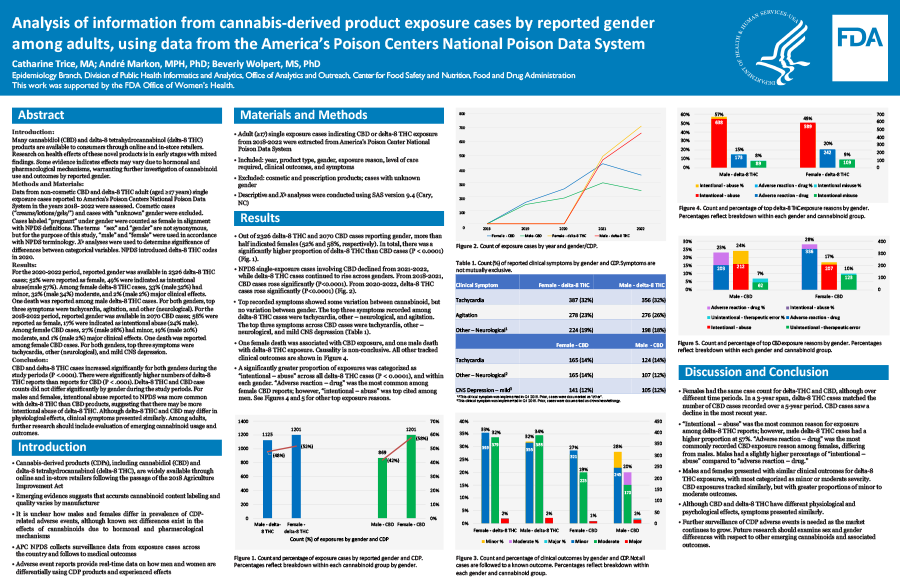
Analysis of information from cannabis-derived product exposure cases by reported sex among adults, using data from the America’s Poison Center National Poison Data System
- Authors:
- Center:
-
Contributing OfficeOffice of the Commissioner
Abstract
Many cannabidiol (CBD) and delta-8 tetrahydrocannabinol (delta-8 THC) products are available to consumers through online and in-store retailers. Research on health effects of these novel products is in early stages with mixed findings. Some evidence indicates effects may vary due to hormonal and pharmacological mechanisms, warranting further investigation of cannabinoid use and outcomes by reported sex. Data from non-cosmetic CBD and delta-8 THC adult (aged ≥17 years) single exposure cases reported to America’s Poison Center National Poison Data System in the years 2018-2022 were assessed. Cosmetic cases (“creams/lotions/gels/”) and cases with “unknown” sex were excluded. Cases labeled “pregnant” under sex were counted as female in alignment with NPDS definitions. The terms “sex” and “sex” are not synonymous, but for the purpose of this study, “male” and “female” were used in accordance with NPDS terminology. Χ2 analyses were used to determine significance of differences between categorical variables. NPDS introduced delta-8 THC codes in 2020. For the 2020-2022 period, reported sex was available in 2326 delta-8 THC cases; 52% were reported as female, 49% were indicated as intentional abuse (male 57%). Among female delta-8 THC cases, 33% (male 32%) had minor, 32% (male 34%) moderate, and 2% (male 2%) major clinical effects. One death was reported among male delta-8 THC cases. For both sexes, top three symptoms were tachycardia, agitation, and other (neurological). For the 2018-2022 period, reported gender was available in 2070 CBD cases; 58% were reported as female, 17% were indicated as intentional abuse (24% male). Among female CBD cases, 27% (male 28%) had minor, 19% (male 20%) moderate, and 1% (male 2%) major clinical effects. One death was reported among female CBD cases. For both sexes, top three symptoms were tachycardia, other (neurological), and mild CNS depression. CBD and delta-8 THC cases increased significantly for both sexes during the study periods (P <.0001). There were significantly higher numbers of delta-8 THC reports than reports for CBD (P < .0001). Delta-8 THC and CBD case counts did not differ significantly by sex during the study periods. For males and females, intentional abuse reported to NPDS was more common with delta-8 THC than CBD products, suggesting that there may be more intentional abuse of delta-8 THC. Although delta-8 THC and CBD may differ in physiological effects, clinical symptoms presented similarly. Among adults, further research should include evaluation of emerging cannabinoid usage and outcomes.