2023 FDA Science Forum
Adaptive Perfusion: A Novel In Vitro Release Testing Method for Complex Ophthalmic Drug Products
- Authors:
- Center:
-
Contributing OfficeCenter for Drug Evaluation and Research
Abstract
Background:
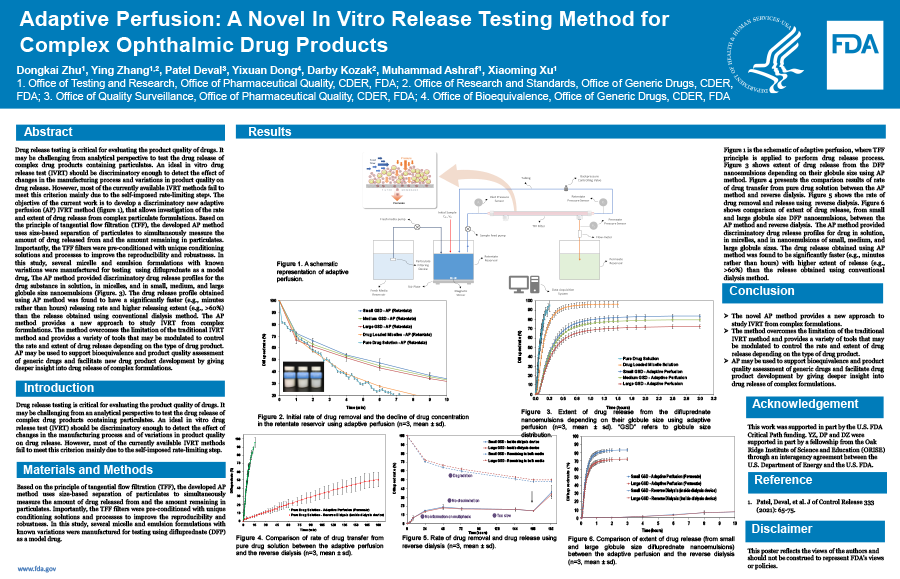
In vitro drug release test is critical for evaluating the product quality of complex drugs, like ophthalmic emulsion drugs. It may be challenging from analytical perspective to test the drug release of complex drug products containing particulates, such as emulsion, suspension, micelles, and liposomes. An ideal in vitro release test (IVRT) should be discriminatory enough to detect the effect of changes in the manufacturing process and variations in product quality on drug release. However, most of the currently available IVRT methods may not be sufficient.
Purpose:
The current work was to show a discriminatory new adaptive perfusion (AP) IVRT method with automated control program that allows investigation of the rate and extent of drug release from complex particulate formulations.
Methodology:
Based on the principle of tangential flow filtration (TFF), the AP method used size-based separation of particulates to simultaneously measure the amount of drug released from and the amount remaining in particulates. A system control program was applied using LabVIEW to achieve the automation of the AP method. In this study, using difluprednate as a model drug, several micelle and emulsion formulations with known variations were manufactured for testing.
Results:
The AP method provided discriminatory drug release profiles for the drug substance in solution, in micelles, and in small, medium, and large globule size nanoemulsions. The drug release profile obtained using this system was found to have a significantly faster (e.g., minutes rather than hours) releasing rate and higher releasing extent than the release obtained using conventional dialysis method. With automation, operational procedures were simplified and reduced while maintaining similar results.
Conclusion:
The AP method overcame the limitation of the traditional IVRT method and provided a new approach to study IVRT from complex formulations. With automation, the system simplified the operational procedures, reduced the personnel burden and offers reliable control mechanism, which paves the way for routine use of the AP method for IVRT studies. AP may be used to support bioequivalence and product quality assessment of generic drugs and facilitate new drug product development by giving deeper insight into drug release of complex formulations.