2021 FDA Science Forum
Adaptive Perfusion: An In Vitro Drug Release Testing Method for Complex Drug Products
- Authors:
- Center:
-
Contributing OfficeCenter for Drug Evaluation and Research
Abstract
Background
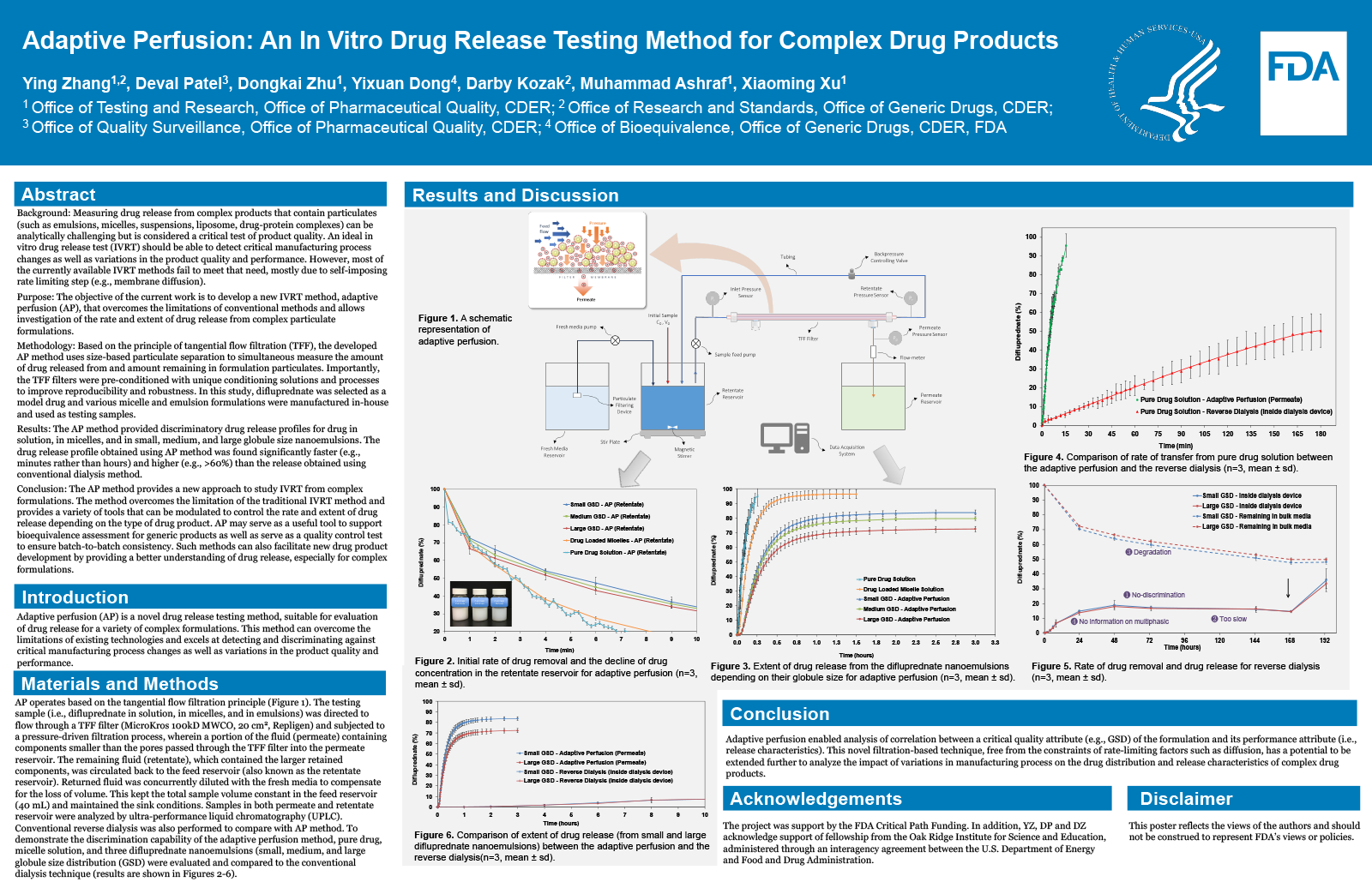
Measuring drug release from complex products that contain particulates (such as emulsions, micelles, suspensions, liposome, drug-protein complexes) can be analytically challenging but is considered a critical test of product quality. An ideal in vitro drug release test (IVRT) should be able to detect critical manufacturing process changes as well as variations in the product quality and performance. However, most of the currently available IVRT methods fail to meet that need, mostly due to self-imposing rate limiting step (e.g., membrane diffusion).
Purpose
The objective of the current work is to develop a new IVRT method, adaptive perfusion (AP), that overcomes the limitations of conventional methods and allows investigation of the rate and extent of drug release from complex particulate formulations.
Methodology
Based on the principle of tangential flow filtration (TFF), the developed AP method uses size-based particulate separation to simultaneous measure the amount of drug released from and amount remaining in formulation particulates. Importantly, the TFF filters were pre-conditioned with unique conditioning solutions and processes to improve reproducibility and robustness. In this study, difluprednate was selected as a model drug and various micelle and emulsion formulations were manufactured in-house and used as testing samples.
Results
The AP method provided discriminatory drug release profiles for drug in solution, in micelles, and in small, medium, and large globule size nanoemulsions. The drug release profile obtained using AP method was found significantly faster (e.g., minutes rather than hours) and higher (e.g., >60%) than the release obtained using conventional dialysis method.
Conclusion
The AP method provides a new approach to study IVRT from complex formulations. The method overcomes the limitation of the traditional IVRT method and provides a variety of tools that can be modulated to control the rate and extent of drug release depending on the type of drug product. AP may serve as a useful tool to support bioequivalence assessment for generic products as well as serve as a quality control test to ensure batch-to-batch consistency. Such methods can also facilitate new drug product development by providing a better understanding of drug release, especially for complex formulations.