2023 FDA Science Forum
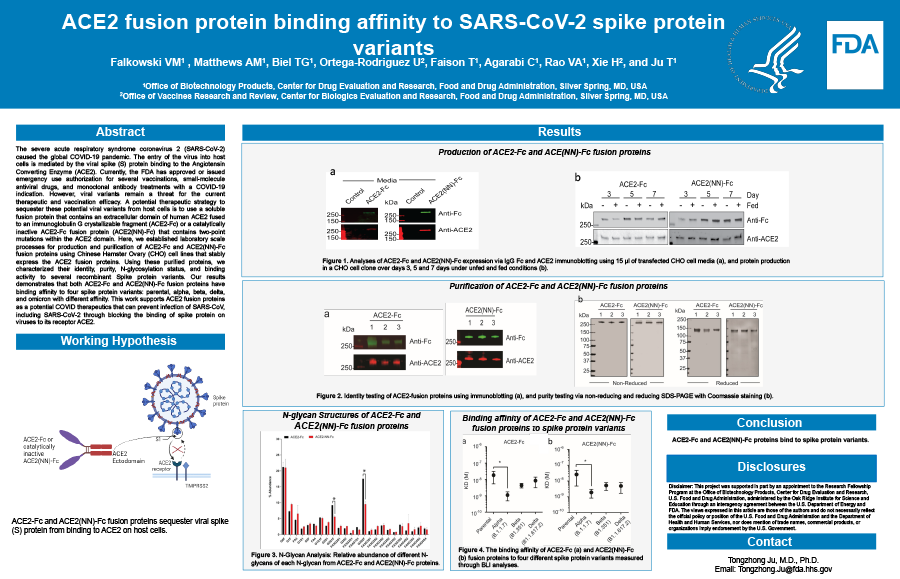
ACE2 fusion protein binding affinity to SARS-CoV-2 spike protein variants
- Authors:
- Center:
-
Contributing OfficeCenter for Drug Evaluation and Research
Abstract
The severe acute respiratory syndrome coronavirus 2 (SARS-CoV-2) caused the global COVID-19 pandemic. The entry of the virus into host cells is mediated by the viral spike (S) protein binding to the Angiotensin Converting Enzyme (ACE2). Currently, the FDA has approved or issued emergency use authorization for several vaccinations, small-molecule antiviral drugs, and monoclonal antibody treatments with a COVID-19 indication. However, viral variants remain a threat for the current therapeutic and vaccination efficacy. A potential therapeutic strategy to sequester these potential viral variants from host cells is to use a soluble fusion protein that contains an extracellular domain of human ACE2 fused to an immunoglobulin G crystallizable fragment (ACE2-Fc) or a catalytically inactive ACE2-Fc fusion protein (ACE2(NN)-Fc) that contains two-point mutations within the ACE2 domain. Here, we established laboratory scale processes for production and purification of ACE2-Fc and ACE2(NN)-Fc fusion proteins using Chinese Hamster Ovary (CHO) cell lines that stably express the ACE2 fusion proteins. Using these purified proteins, we characterized their identity, purity, N-glycosylation status, and binding activity to several recombinant Spike protein variants. Our results demonstrates that both ACE2-Fc and ACE2(NN)-Fc fusion proteins have binding affinity to four spike protein variants: parental, alpha, beta, delta, and omicron with different affinity. This work supports ACE2 fusion proteins as a potential COVID therapeutics that can prevent infection of SARS-CoV, including SARS-CoV-2 through blocking the binding of spike protein on viruses to its receptor ACE2.