2021 FDA Science Forum
3D-SDAR Classification Models for Large and Diverse Sets of Opioid and Cannabinoid Receptors Binders. Structural Factors Affecting Binding to Cannabinoid Receptor Type 1 and mu, Kappa and Delta Opioid Receptors.
- Authors:
- Center:
-
Contributing OfficeNational Center for Toxicological Research
Abstract
Background
Addiction is a complex behavioral phenomenon in which naturally occurring or synthetic chemicals, through their binding to a variety of neuroreceptors, modulate the response of the reward system, resulting in compulsive substance-seeking (Can. Med. Assoc. J. 164.6, 2001, 817). Among these, the opioid and cannabinoid systems play a critical role in the addiction to powerful prescription and illicit drugs.
Purpose
Having in mind the profound effect of the opioid and cannabinoid systems on human behavior and the multitude of unprofiled synthetics entering the illegal market each year, properly validated, large scale models for binding to the mu, kappa and delta opioid receptors (MOR, KOR and DOR) as well as cannabinoid receptor type 1 (CB1R) are surprisingly lacking.
Methodology
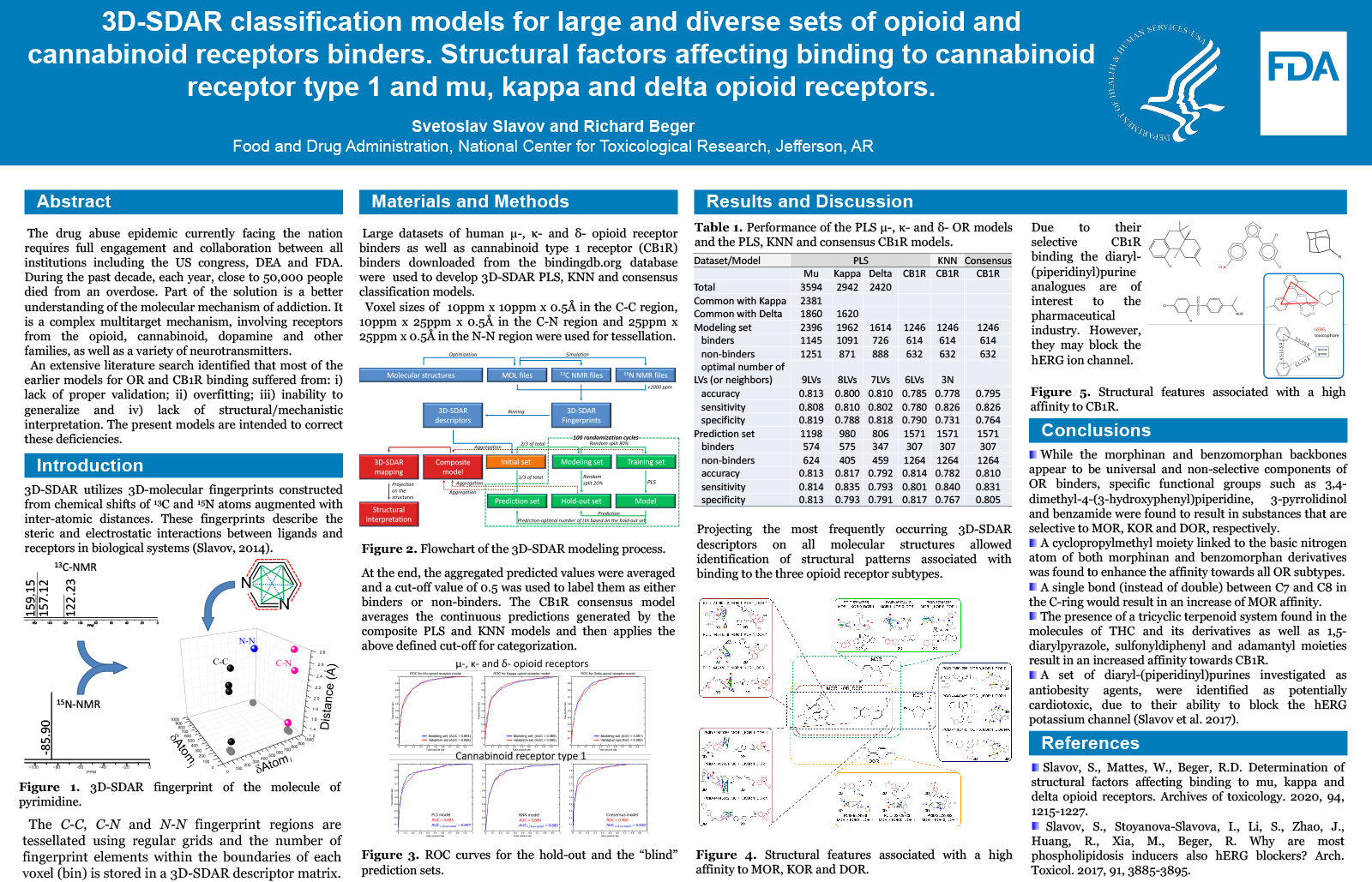
Three-dimensional spectroscopic data-activity relationship models for 3594, 2942, 2420 and 2817 MOR, KOR, DOR and CB1R binders were developed. The compounds in the initial datasets were split into balanced modeling and “blind” prediction subsets using a reproducible algorithm based on ranked molecular weights. All chemicals with Ki < 100nM were classified as binders, whereas those with Ki ≥ 100nM were classified as non-binders. For each dataset, a total of 100 randomized PLS models splitting the modeling set into training (80%) and hold-out test (20%) sets were generated and used to predict the binding class of the chemicals in the prediction sets.
Results
The accuracy, sensitivity and specificity for the “blind” prediction subsets consistently exceeded 0.8 and were significantly higher after removal of the inconclusives near the cut-off. The AUC values for all prediction subsets exceeded 0.88. Morphinan and benzomorphan backbones were identified as universal and non-selective components of OR binders, whereas specific functional groups such as 3,4-dimethyl-4-(3-hydroxyphenyl)piperidine, 3-pyrrolidinol and benzamide were found to result in substances that are selective to MOR, KOR and DOR, respectively. On the other hand, in addition to the classical tricyclic terpenoid system found in the molecules of THC and its derivatives, CB1R also was selective to halogenated diarylpyrazoles and diaryl-(piperidinyl)purines.
Conclusions
These results demonstrate the ability of 3D-SDAR to predict accurately the binding class of MOR, KOR, DOR and CB1R binders as well as to extract relevant structural features.