


Understanding the FDA’s Systematic Process for Ensuring the Post-Market Safety of Chemicals in Food
Through pre-market food chemical review programs, the FDA ensures the safety of new uses of chemicals in food. Our post-market programs ensure the continued safety of the food supply by evaluating substances added to or in contact with food and monitoring the risk posed by chemical contaminants. FDA regularly assesses new data and information for these chemicals as they become available. To enhance these programs, the agency has developed a robust, science-driven, and transparent process for the assessment of chemicals already in the food supply.
- Introduction
- How We Identify and Prioritize Chemicals for Review
- The Scientific Assessment Process
- Yearly Work Plans
- Frequently Asked Questions
- Key Documents
Introduction
FDA first introduced this process to the public in a discussion paper and at a public meeting. We revised the process based on comments submitted to a docket. The process has four main steps:
- Signal identification/triage
- Prioritization
- Scientific assessment
- Risk management
We use cutting-edge tools and the best available science to detect, characterize, and assess potential adverse health effects from food chemicals. This systematic yet flexible process ensures that regulatory decisions reflect current toxicological science and are based on the best available scientific evidence.
All food chemicals reviewed as part of this process will be posted on this webpage as well as on our List of Select Chemicals in the Food Supply Under FDA Review, which will be regularly updated to provide transparency of what we are reviewing and where each food chemical is in the process.
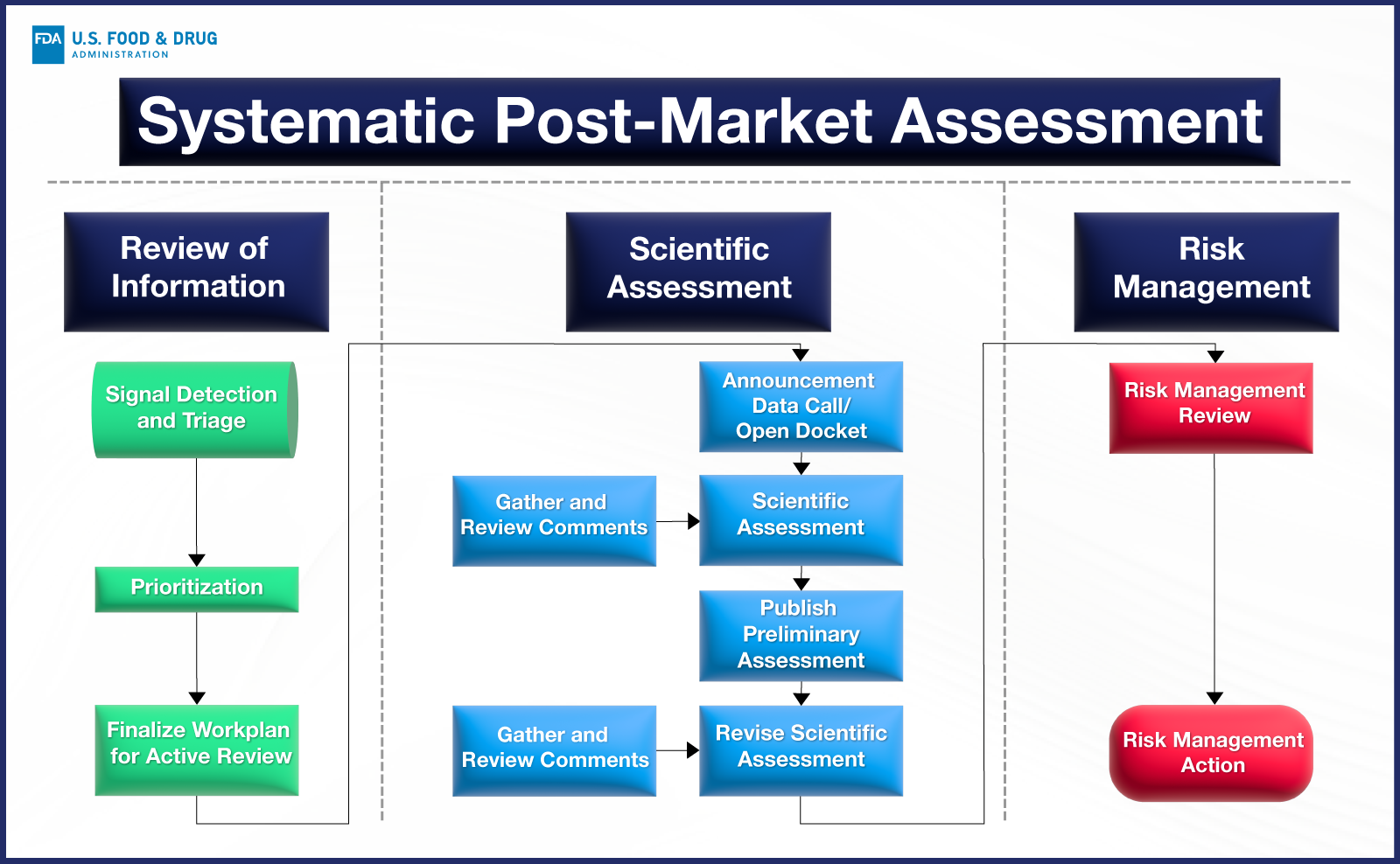
This figure represents a high level overview of the Systematic Post-Market Assessment process. The full details of this process are available in the Enhanced Systematic Process for FDA’s Post-Market Assessment of Chemicals in Food.
How We Identify and Prioritize Chemicals for Review
Our process begins by actively looking for “signals,” which are any information that suggests a potential safety concern with a chemical found in food. Using artificial intelligence and other tools, we identify these signals from many sources, including new and existing scientific studies, news reports, adverse event reports, and findings from other health organizations worldwide. This ensures that both emerging issues and previously identified concerns are considered for assessment.
Once we identify a signal, our scientific staff reviews it to determine the best course of action in a process called triage. Signal triage determines if a signal points to an immediate risk that requires urgent action (such as a specific contaminated product), if it should move forward for a full scientific assessment, or if the food chemical needs additional monitoring until more information is available. Certain signals, such as an adverse finding from a peer food safety authority, may also lead us to begin a scientific assessment immediately to ensure we are addressing potential public health issues in a timely manner.
For food chemicals that we determine are ready for a full scientific assessment, we use a science-based process to prioritize our work. We rank chemicals to help determine which ones should be assessed first using a prioritization tool that was developed with public input and was externally peer-reviewed. This tool assists us in setting priorities for our annual work plan by focusing on chemicals that may have the greatest potential for a negative public health impact. It is important to note that this prioritization process does not determine if a chemical is safe or unsafe; rather, it is a science-based, systematic method that helps ensure we are dedicating our resources to the most significant food chemical safety questions.
The Scientific Assessment Process
Once a chemical has been prioritized and selected for review, our expert scientists conduct a thorough scientific assessment to evaluate its safety. This is a rigorous, multi-step process designed to be transparent and incorporate feedback from the public. The scope of each assessment is tailored to the specific chemical and the available scientific information.
Step 1: Gathering Information
Our first step is to gather all relevant scientific data and information. We publish a Request for Information in the Federal Register, opening a public docket for 60 days to give all stakeholders—including industry, academia, consumer groups, and the public—an opportunity to submit information. We may request data on the chemical’s current uses in foods, how much of it people might consume, and any unpublished safety or toxicology studies. This public input is vital for ensuring our assessments are based on the most current and comprehensive information available.
Step 2: Developing the Preliminary Scientific Assessment
Using the information gathered from the Request for Information and other sources, including published scientific literature and our own internal data, FDA scientists develop a preliminary scientific assessment. This involves:
- Evaluating all available studies for scientific soundness and quality.
- Estimating dietary exposure by combining data on what Americans eat with information on the amount of the chemical present in food, paying special attention to potentially vulnerable groups, such as children.
- Assessing potential health hazards and reviewing toxicological data to understand any potential adverse health effects.
- Synthesizing the evidence to characterize the potential risk to consumers.
Step 3: Seeking Public Comment
To ensure transparency and scientific rigor, we publish the preliminary scientific assessment on our List of Select Chemicals in the Food Supply Under FDA Review webpage and provide another 60-day public comment period. This provides the public an opportunity to review our work, give feedback, and suggest alternative interpretations for our consideration.
Step 4: Finalizing and Publishing the Assessment
After the comment period closes, we carefully review all feedback from the public and revise the assessment as needed. The final scientific assessment is published on our List of Select Chemicals in the Food Supply Under FDA Review webpage, providing a transparent record of our findings. The conclusions of this assessment inform the final stage of our process: risk management.
Taking Action: Risk Management
Once the scientific assessment is complete, we determine whether we need to take action to ensure the safety of the food supply and protect public health. Examples of actions the FDA may take to protect public health include revoking or amending authorizations for certain uses, working with industry on voluntary market phase-out agreements and recalls, refusing imported food products, developing action levels or specified limits for contaminants, or issuing alerts. We publish the results of our final assessments even if we determine that no action needs to be taken.
Yearly Work Plans
FY 2026
Frequently Asked Questions
This systematic process is a new, proactive mechanism designed to complement the FDA’s existing food chemical safety programs, such as the food additive and color additive petition processes, the Closer to Zero initiative for contaminants, and responses to immediate public health risks. Its primary function is to systematically identify, prioritize, and transparently assess chemicals that are already in the food supply.
No. The inclusion of a chemical on our work plan or list of substances under review does not mean it is unsafe or that it poses a risk to consumers. It simply means that the FDA is conducting an updated scientific assessment of the chemical and its current uses based on new or changing scientific information.
The duration of a post-market assessment varies on a case-by-case basis and does not have a fixed timeline. The completion time depends on several factors, including the scale and complexity of the assessment, which is tailored to the specific chemical and the available science. Agency resources and competing priorities, such as urgent public health matters, also influence how many assessments can be undertaken and their duration. The process includes built-in public engagement steps, such as 60-day comment periods, which are factored into the overall timeline. While there is no set overall timeline, the FDA is committed to transparency and will provide regular status updates for ongoing assessments on our List of Select Chemicals in the Food Supply Under FDA Review webpage.
Our assessments are based on the best available science from all available sources. This includes published scientific literature, data from other government and international bodies, our own internal data, and information submitted by all stakeholders, including industry, during our public data calls.
The FDA’s decisions are strictly based on sound science and quality scientific data, and the standards for evaluating data in these post-market assessments are the same rigorous standards used for pre-market reviews. Our scientists conduct a critical evaluation of all available studies for their scientific soundness and reliability, including whether they used appropriate methods and meet current scientific standards. Assessments are based on the “weight of scientific evidence,” which synthesizes the best available science from all sources—including published literature, government data, and information submitted by all stakeholders—to form a conclusion.
We have built multiple opportunities for public engagement into this process to ensure transparency and rigor. Stakeholders can participate by submitting information in response to our Requests for Information and providing comments on our published preliminary scientific assessments.
The Federal Food, Drug, and Cosmetic Act contains provisions, often referred to as the Delaney Clause, for food and color additives. With respect to food additives and color additives intended for use in food, the Delaney Clause states that no food additive or color additive shall be deemed safe if it is found to induce cancer when ingested by humans or animals, or if it is found, after tests which are appropriate for the evaluation of the safety of such additives, to induce cancer in humans or animals. Therefore, this systematic process treats signals of carcinogenicity for certain chemicals with high priority. If evidence suggests an approved food additive or color additive induces cancer, we will conduct an expedited assessment. If the evidence is confirmed, we will take action to revoke the authorizations for that food or color additive.
The FDA must conduct its own scientific assessments and make risk management decisions based on the safety standards set by U.S. federal law. However, we routinely review the scientific work of international bodies like the European Food Safety Authority, and an adverse finding from such an authority is considered an important signal that may lead us to immediately begin our own scientific assessment.
Key Documents
The documents below provide a comprehensive look at our enhanced systematic process and the prioritization tool.
The Enhanced Systematic Process for FDA’s Post-Market Assessment of Chemicals in Food: This paper provides a complete overview of the entire post-market assessment process and details how we incorporated stakeholder feedback from public comments and meetings to shape our approach.
Tool for the Prioritization of Food Chemicals for Post-Market Assessment: This paper explains the development and methodology of the externally peer-reviewed tool we use to help prioritize chemicals for post-market assessment.