


Modern Intact NMR Approach Reveals Synchronized Microstructural Changes in Nanoemulsion Drug Formulations
A recently developed nuclear magnetic resonance (NMR) approach enabled CDER researchers to non-invasively characterize microstructure properties in complex oil-in-water nanoemulsion ophthalmic formulations. This work advances the scientific understanding of how formulation and process variations affect drug distribution within complex formulations such as nanoemulsions.
Background
Difluprednate was approved as an orphan drug to treat post-operative ocular inflammation and pain. Because the drug was insoluble in water, difluprednate was formulated as an oil-in-water nanoemulsion. Oil-in-water nanoemulsions are stabilized suspensions of nano-sized drops of oil (less than 100 nm, typically), where in this case the oil drops contain the difluprednate which is soluble in oil. Molecules that have a hydrophilic head and a hydrophobic tail called surfactants were used to promote stability of the suspension. The performance and stability of nanoemulsions are sensitive to process and formulation parameters, which must be carefully controlled to maintain desired drug properties, and for this reason drugs formulated as nanoemulsions are designated as complex products, which can raise unique scientific and regulatory challenges. Difluprednate nanoemulsions are typically formed by high-energy mixing of difluprednate, water, oil, surfactants and other excipients. The final formulation consists of oil globules averaging 100 nanometers in diameter that are dispersed in the aqueous phase and stabilized by surfactants. To have their product approved by the FDA, sponsors of complex generic drugs are required to demonstrate that their products are both qualitatively (Q1: same components) and quantitatively (Q2: same components in same concentration) similar to the reference drug product, and equally important, they need to demonstrate microstructural similarity (Q3) to the reference listed drug.
Scientific and regulatory challenges
For oil-in-water nanoemulsion formulations, critical quality attributes include microstructural characteristics (such as distribution of the drug molecules across the phases), oil globule size, and other physical characteristics such as viscosity. Because the difluprednate nanoemulsion formulation is composed of non-covalently stabilized soft-core oil globules, the drug distribution is sensitive to sample preparation techniques (e.g., ultracentrifugation) that may alter the microstructure. Ideally, measurements should be done on the as-dispensed drug product without perturbation of the formulation, which poses a difficult scientific challenge. The small size of the globules makes characterization challenging, and furthermore they are sensitive to thermodynamic phenomena such as aggregation and Ostwald ripening (a process in which smaller globules dissolve and redeposit into larger more thermodynamically stable globules). Due to these challenges, there had been no published non-invasive, as-is methods (i.e., methods that do not require dilution or other manipulations) to characterize the drug molecule distribution in difluprednate nanoemulsion, and thus there are gaps in understanding of formulation and process parameter effects on the final product. This lack of product understanding has been a hurdle for generic drug development and the FDA’s ability to grant generic drug approval.
Intact NMR method development
In 2018, CDER researchers began developing NMR spectroscopy1 to characterize oil-in-water NE formulations. NMR spectroscopy1 is a non-invasive analytical method and can be applied to the intact drug product directly without any sample manipulation and therefore allows for unambiguous interpretation of the structural states of a drug, excipients, and the interactions between them. Initially, two-dimensional (2D) 1H diffusion ordered spectroscopy (DOSY) NMR was applied to obtain the oil globule size distributions for originator product nanoemulsion formulations of difluprednate, cyclosporine, and propofol (average globule sizes were 80 nm, 100 nm, and 260 nm, respectively). The DOSY results for these formulations were consistent with size measurements based on dynamic light scattering and asymmetric flow field flow fractionation, demonstrating that DOSY-NMR was a valid orthogonal approach for determining globule size distributions.
To measure the drug phase distribution, the spin-active nuclei 19F in difluprednate were used as a probe to map drug distribution in nanoemulsion formulations. The 19F NMR signals were used to differentiate between difluprednate located in water, the surfactant layer of the globules, or the globule oil core (Figure 1). The NMR peak broadening analysis also showed that the difluprednate drug was not restricted to globules but could be exchanged between neighboring globules (labelled NE in Figure 1) through the smaller swollen micelles or micro-emulsions (labelled ME in Figure 1) that are energetically more favorable. The drug exchange between ME and NE globules is at the time scale of every 0.01-0.02 seconds in the intact formulation.
Figure 1.
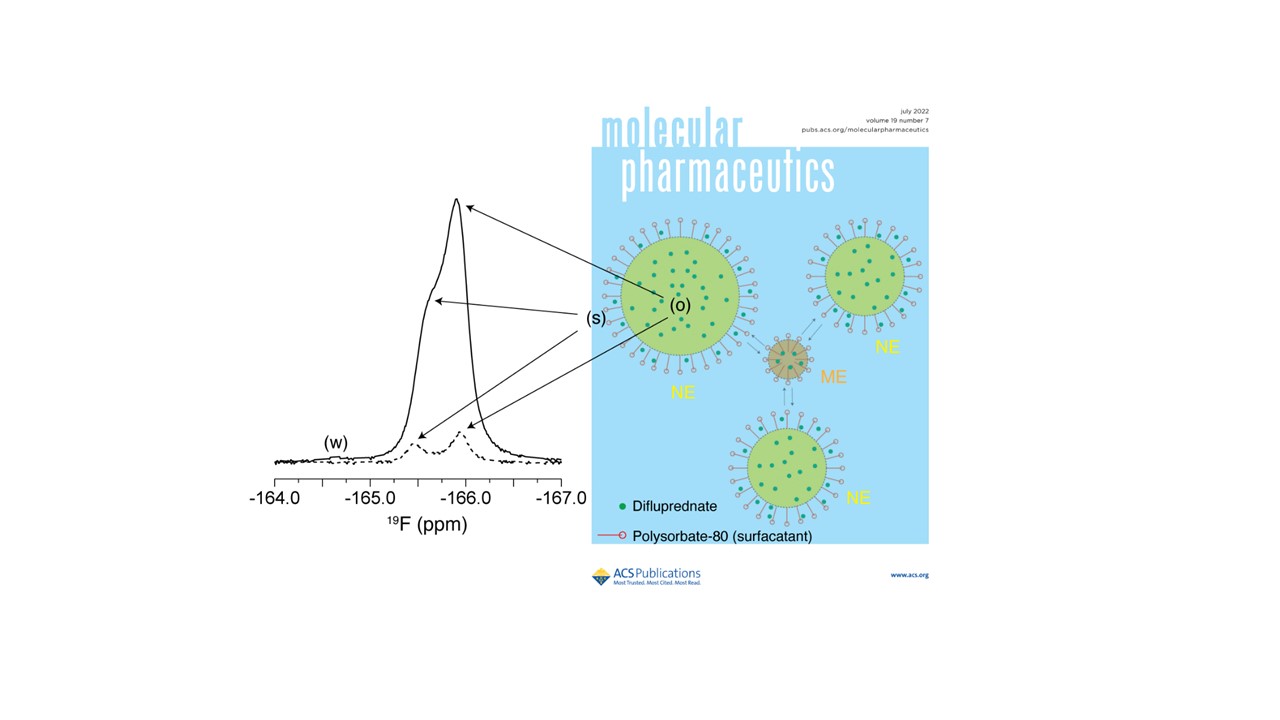
Figure 1. The 19F NMR spectra of difluprednate drug product Durezol® (left) and the journal cover cartoon (right) showing difluprednate drug (green dots) distribution and exchange between oil globules of nano-emulsion (NE, yellow) and micro-emulsion (ME, orange), i.e., swollen-micelle. The spectrum of intact drug product (black) was superimposed with the 10-fold diluted drug product (dashed black). NMR signals corresponding to drug distributions in water (w), surfactant layer (s) and oil core (o) of NE globules, were annotated.
Synchronized microstructural change upon formulation modification
While the study found that the microstructure attributes of difluprednate drug phase distribution and oil globule size could be measured using 1D 19F and 2D 1H DOSY NMR spectra, the NMR sensitivity to formulation changes needed to be validated, which would need a validation procedure to assess if a new analytical method was fit-for-purpose. To accomplish this goal, three difluprednate nanoemulsion formulations containing the same amount of difluprednate were prepared. The first formulation was a 10-fold dilution nanoemulsion drug product solution, and based on this formulation two modified formulations were prepared: one was spiked with more surfactant and the other was mechanically shaken to alter the globule size while keeping formulation parameters constant. Through different molecular mechanisms, the spiked or shaken modified formulations exhibited a reduction in oil globule size. Measured using DOSY, the surfactant spiking formulation resulted in an averaged globule size reduction from 80 nm to 50 nm. The process of globular size reduction is driven by potential energy differences in globule curvatures, a type of compositional ripening exchange. The reduction in globule size is synchronized with an increase in overall globule surface area, leading to a greater distribution of difluprednate in the surfactant phase, as evidenced by 19F NMR (Figure 2). On the other hand, mechanical shaking caused globules to collide more frequently, resulting in the conversion of NE globules to the much smaller ME globules of 30 nm, and the drug molecules redistributed to ME, i.e., swollen micelles. The ME or swollen micelle, having the lowest free energy, is composed of well-mixed globule phase of surfactant and oil.
Figure 2.
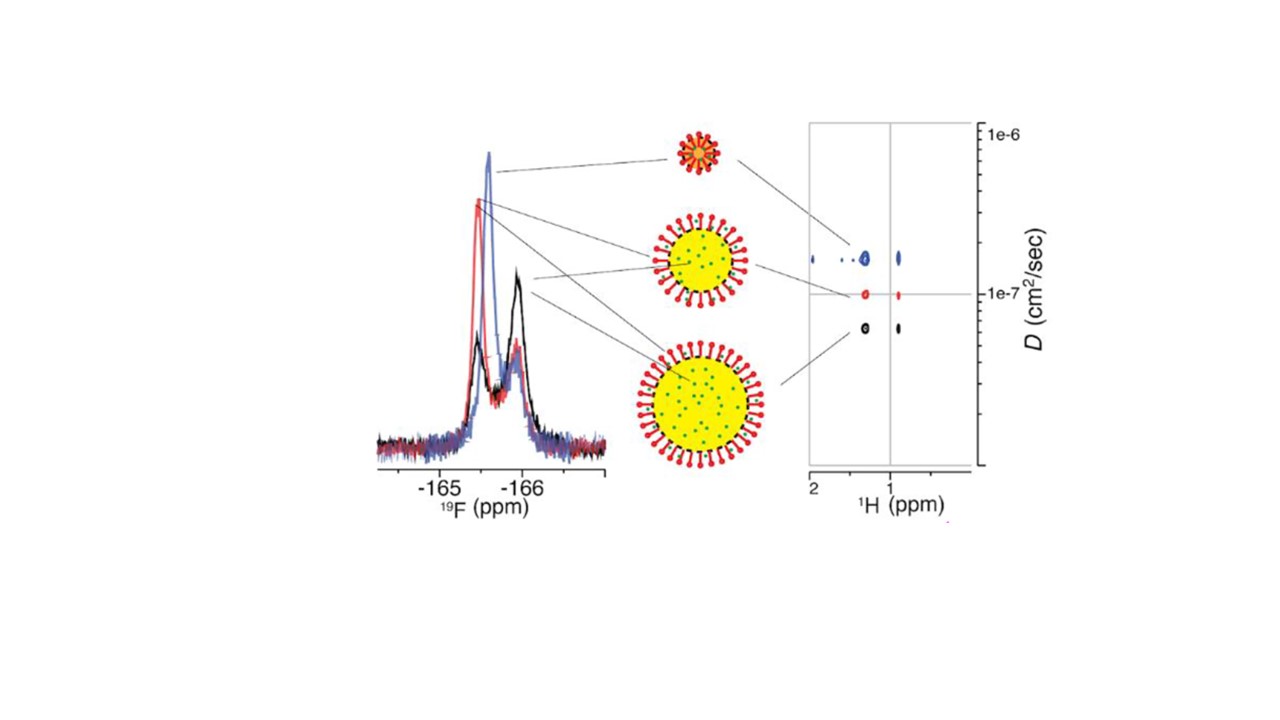
Figure 2. The synchronized microstructural changes of difluprednate nanoemulsion (NE) formulation upon surfactant addition or mechanic perturbation. The difluprednate drug (green dots) phase distribution change is reflected in 19F NMR spectra (left). The oil globule size change is reflected in 2D 1H DOSY NMR spectra (right). Oil globules of nano-emulsion (NE, yellow) and micro-emulsion (ME, orange) or swollen-micelle are illustrated (middle). (The figure is from the graphical abstract of Wang et al. 2024).
Because of the sensitivity of NMR data to the local atomic molecular environment, the correlated microstructure changes in these nanoemulsion formulations were observed by 19F NMR for the first time. Therefore, the intact NMR approach that was developed through this work provides a new diagnostic tool for molecular microstructure or Q3 properties in oil-in-water nanoemulsion formulation development, and, ultimately, for quality assurance after manufacturing process or formulation changes.
How does this work advance generic drug development?
Based on data obtained in this study, intact NMR methods for characterization of nanoemulsion can now be recommended to generic drug sponsors. These sensitive and accurate analytical methods may save resources for pharmaceutical industry, accelerate generic drug development and enhance the quality assessment of these drugs, ultimately resulting in lower costs to American public. In addition, this study advanced understanding of the microstructure and dynamics at the molecular level of complex oil-in-water nanoemulsion drug formulations, providing a scientific underpinning for improving this class of complex generic drugs to provide greater quality assurance and confidence in each dose.
References
Petrochenko P., Pavurala N., Wu Y., Wong S., Parhiz H., Chen K., Patil S., Qu H., Buoniconti P., Muhammad A, Choi S., Kozak D., Ashraf M., Cruz C., Zheng J., Xu X. Analytical considerations for measuring the globule size distribution of cyclosporine ophthalmic emulsions. Int. J. Pharm. 2018 550, 229-239. https://doi.org/10.1016/j.ijpharm.2018.08.030
Patil S., Li V., Peng J., Kozak D., Xu J., Cai B., Keire D. & Chen K. A Simple and Non-invasive DOSY NMR Method for Droplet Size Measurement of Intact Oil-in-Water Emulsion Drug Products. J. Pharm. Sci. 2019 108, 815-820. https://doi.org/10.1016/j.xphs.2018.09.027
Wang D., Park J., Zheng J., Cai B., Keire D. & Chen. K., Multiphase Drug Distribution and Exchange in Oil-in-Water Nano-Emulsion revealed by High-Resolution 19F qNMR, Mol. Pharm. 2022, 19, 2142-2150. https://doi.org/10.1021/acs.molpharmaceut.2c00025
Wang, D., Li, J. & Chen, K. Intact NMR Approach Quickly Reveals Synchronized Microstructural Changes in Oil-in-Water Nanoemulsion Formulations. AAPS J 2024 26, 78. https://doi.org/10.1208/s12248-024-00945-3
Footnotes
1Nuclear magnetic resonance (NMR) spectroscopy is a technique that uses radio waves to study the chemical and physical properties of materials. It's a non-invasive and non-destructive way to analyze the structure of molecules.