


Stress Urinary Incontinence (SUI)
On this page:
- What is Stress Urinary Incontinence?
- What are the Treatment Options for Women with Stress Urinary Incontinence?
- What Questions Should I Ask My Surgeon If I am Considering Surgery to Treat Stress Urinary Incontinence?
- What Should I Do After My Surgery to Treat Stress Urinary Incontinence?
What is Stress Urinary Incontinence?
Stress urinary incontinence (SUI) is a leakage of urine during moments of physical activity that increases abdominal pressure, such as coughing, sneezing, laughing, or exercise. SUI is the most common type of urinary incontinence in women.
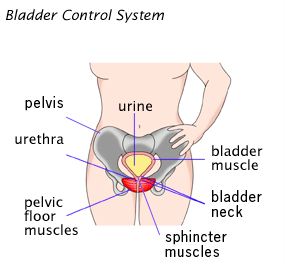
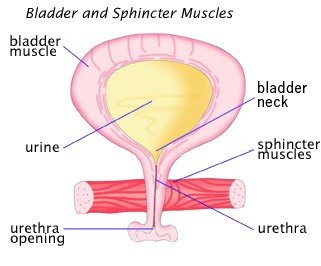
SUI can happen when pelvic tissues and muscles, which support the bladder and urethra, become weak and allow the bladder "neck" (where the bladder and urethra intersect) to descend during bursts of physical activity. This descent can prevent the urethra from working properly to control the flow of urine. SUI can also occur when the sphincter muscle that controls the urethra weakens. The weakened sphincter muscle is not able to stop the flow of urine under normal circumstances and when there is an increase in abdominal pressure. Weakness may occur from pregnancy, childbirth, aging, or prior pelvic surgery. Other risk factors for SUI include chronic coughing or straining, obesity and smoking.
It is important for you to consult with your health care provider for proper diagnosis of SUI.
Image Source: National Kidney and Urologic Diseases Information Clearinghouse
What are the Treatment Options for Women with Stress Urinary Incontinence?
Women have both non-surgical and surgical options to treat SUI.
Not every woman with SUI will need surgery. Some factors you should consider before deciding whether to undergo surgery include:
- the severity of your SUI symptoms and their effect on your daily activities;
- your desire for future pregnancy as vaginal delivery can cause recurrence of SUI symptoms, which could require future surgery
NONSURGICAL TREATMENT OPTIONS
Examples of nonsurgical treatment options for SUI include:
- Pelvic Floor Exercises: A type of exercise to strengthen the pelvic floor by contracting and relaxing the muscles that surround the opening of the urethra, vagina, and rectum. These exercises, commonly referred to as Kegel exercises, improve the muscles’ strength and function and may help to hold urine in the bladder longer.
- Pessary: A removable device that is inserted into the vagina against the vaginal wall and urethra to support the bladder neck. This helps reposition the urethra to reduce SUI.
- Transurethral Bulking Agents: Collagen injections around the urethra that make the space around the urethra thicker, thus helping to control urine leakage. The effects may not be permanent.
- Behavioral Modification: This includes avoiding activities that trigger episodes of leaking.
SURGICAL TREATMENT OPTIONS
Surgery to decrease or prevent urine leakage can be done through the vagina or abdomen. The urethra or bladder neck is supported with either stitches alone or with tissue surgically removed from other parts of the body such as the abdominal wall or leg (fascial sling), with tissue from another person (donor tissue) or with material such as surgical mesh (mesh sling).
Surgical mesh in the form of a "sling" (sometimes called "tape") is permanently implanted to support the urethra or bladder neck in order to correct SUI. This is commonly referred to as a "sling procedure."
The use of surgical mesh slings to treat SUI provides a less invasive approach than non-mesh repairs, which require a larger incision in the abdominal wall. The multi-incision sling procedure can be performed using three incisions, in two ways: with one vaginal incision and two lower abdominal incisions, called retropubic; or with one vaginal incision and two groin/thigh incisions, called transobturator. There is also a "mini-sling" procedure that utilizes a shorter piece of surgical mesh, which may be done with only one incision.
Image Source: National Kidney and Urologic Diseases Information Clearinghouse
What Questions Should I Ask My Surgeon If I am Considering Surgery to Treat Stress Urinary Incontinence?
Ask your surgeon about all SUI treatment options, including non-surgical options and surgical options that do and do not use mesh slings. It is important for you to understand why your surgeon may be recommending a particular treatment option to treat your SUI.
Any surgery for SUI may put you at risk for complications, including additional surgery. One complication that may occur when mesh slings are used is vaginal mesh erosion, which could require additional surgery to resolve.
If mesh erosion occurs through the vaginal tissue, it is possible that men may experience penile irritation and/or pain during sexual intercourse.
Ask your surgeon the following questions before you decide to have SUI surgery:
- What surgical or non-surgical treatment options are available and what do you recommend to treat my SUI?
- Have you had specialized training in the surgical treatment of SUI, and if so, what type of training have you had with this particular product and/or procedure?
- What can I expect after surgery and what is the recovery time?
- If I also have pelvic organ prolapse, will that change how you treat my SUI?
- What if the surgery doesn’t correct my problem?
- Which side effects should I report to you after the surgery?
- Are you planning to use a mesh sling in my surgery? If so:
- How often have you performed this surgery using this particular product? What results have your other patients had with this product?
- What are the pros and cons of using a mesh sling in my particular case? How likely is it that my repair could be successfully performed without using a mesh sling?
- Are recovery times different for mesh sling surgery compared to non-mesh surgery?
- Will my partner be able to feel the mesh sling during sexual intercourse?
- If I have a complication related to the mesh sling, how likely is it that the complication can be resolved? Will you treat it or will I be referred to a specialist experienced with mesh sling complications?
- Is there patient information that comes with the product, and can I have a copy?
What Should I Do After My Surgery to Treat Stress Urinary Incontinence?
- Continue with annual check-ups and follow-up care, notifying your health care provider if complications develop, such as persistent vaginal bleeding or discharge, pelvic or groin pain, or pain during sexual intercourse. There is no need to take additional action if you are satisfied with your surgery and are not having complications or symptoms.
- If you have complications or other symptoms:
- Discuss complications and treatment options with your health care provider. Only your health care provider can give you personalized medical advice.
- Consider getting a second opinion from a surgeon who specializes in female pelvic reconstruction if you are not satisfied with your discussion with your health care provider.
- Let your health care provider know you have a mesh sling, especially if you plan to have another surgery, plan to become pregnant or have other medical procedures.
- If you have had SUI surgery but do not know whether your surgeon used a mesh sling, ask your health care provider.
- Talk to your health care provider about any additional questions you may have.
- Submit a voluntary report about any problems experienced with surgical mesh slings through Medwatch, the FDA Safety Information and Adverse Event Reporting program.