2023 FDA Science Forum
New Method to Power High Frequency Tanning Lamps with Varied Parameters for Measuring Ultraviolet Radiation Output
- Authors:
- Center:
-
Contributing OfficeOffice of Regulatory Affairs
Abstract
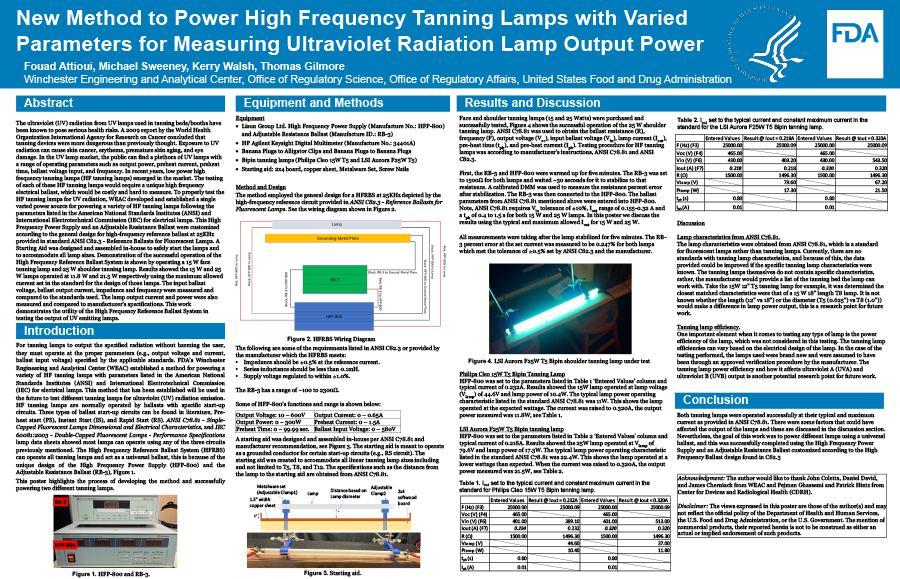
The ultraviolet (UV) radiation from UV lamps used in tanning beds/booths have been known to pose serious health risks. A 2009 report by the World Health Organization International Agency for Research on Cancer concluded that tanning devices were more dangerous than previously thought. Exposure to UV radiation can cause skin cancer, erythema, premature skin aging, and eye damage. In the UV lamp market, the public can find a plethora of UV lamps with a range of operating parameters such as output power, preheat current, preheat time, ballast voltage input, and frequency.
In recent years, low power high frequency tanning lamps (HF tanning lamps) emerged in the market. The testing of each of these HF tanning lamps would require a unique high frequency electrical ballast, which would be costly and hard to measure. To properly test the HF tanning lamps for UV radiation, WEAC developed and established a single varied power source for powering a variety of HF tanning lamps following the parameters listed in the American National Standards Institutes (ANSI) and International Electrotechnical Commission (IEC) for electrical lamps. This High Frequency Power Supply and an Adjustable Resistance Ballast were customized according to the general design for high-frequency reference ballast at 25KHz provided in standard ANSI C82.3 - Reference Ballasts for Fluorescent Lamps.
A Starting Aid was designed and assembled in-house to safely start the lamps and to accommodate all lamp sizes. Demonstration of the successful operation of the High Frequency Reference Ballast System is shown by operating a 15 W face tanning lamp and 25 W shoulder tanning lamp. Results showed the 15 W and 25 W lamps operated at 11.8 W and 21.5 W respectively using the maximum allowed current set in the standard for the design of those lamps. The input ballast voltage, ballast output current, impedance and frequency were measured and compared to the standards used. The lamp output current and power were also measured and compared to manufacturer's specifications. This work demonstrates the utility of the High Frequency Reference Ballast System in testing the output of UV emitting lamps.