2023 FDA Science Forum
Evaluation of the Physical Impact of Implant Micromotion on the Cellular Environment of the Soft Tissue-Biomaterial Interface
- Authors:
- Center:
-
Contributing OfficeCenter for Devices and Radiological Health
Abstract
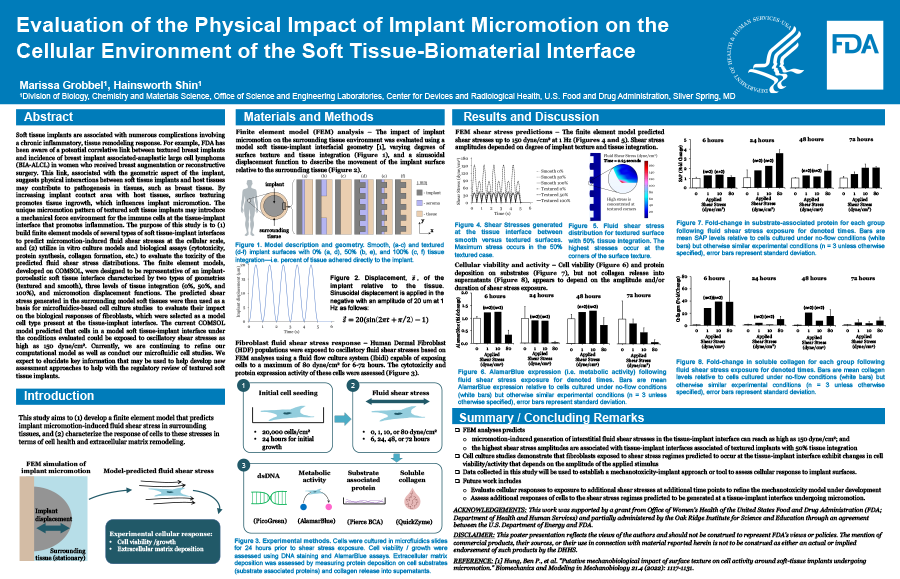
Soft tissue implants are associated with numerous complications involving a chronic inflammatory, tissue remodeling response. For example, FDA has been aware of a potential correlative link between textured breast implants and incidence of breast implant associated-anaplastic large cell lymphoma (BIA-ALCL) in women who received breast augmentation or reconstructive surgery. This link, associated with the geometric aspect of the implant, suggests physical interactions between soft tissue implants and host tissues may contribute to pathogenesis in tissues, such as breast tissue. By increasing implant contact area with host tissues, surface texturing promotes tissue ingrowth, which influences implant micromotion. The unique micromotion pattern of textured soft tissue implants may introduce a mechanical force environment for the immune cells at the tissue-implant interface that promotes inflammation. The purpose of this study is to (1) build finite element models of several types of soft tissue-implant interfaces to predict micromotion-induced fluid shear stresses at the cellular scale, and (2) utilize in vitro culture models and biological assays (cytotoxicity, protein synthesis, collagen formation, etc.) to evaluate the toxicity of the predicted fluid shear stress distributions. The finite element models, developed on FEBio, were designed to be representative of an implant-poroelastic soft tissue interface characterized by two types of geometries (textured and smooth), three levels of tissue integration (0%, 50%, and 100%), and micromotion displacement functions. The predicted shear stress generated in the surrounding model soft tissues were then used as a basis for microfluidics-based cell culture studies to evaluate their impact on the biological responses of fibroblasts, which were selected as a model cell type present at the tissue-implant interface. The current FEBio model predicted that cells in a model soft tissue-implant interface under the conditions evaluated could be exposed to oscillatory shear stresses as high as 60 dyne/cm2. Currently, we are continuing to refine our computational model as well as conduct our microfluidic cell studies. We expect to elucidate key information that may be used to help develop new assessment approaches to help with the regulatory review of textured soft tissue implants (e.g., breast implants).